
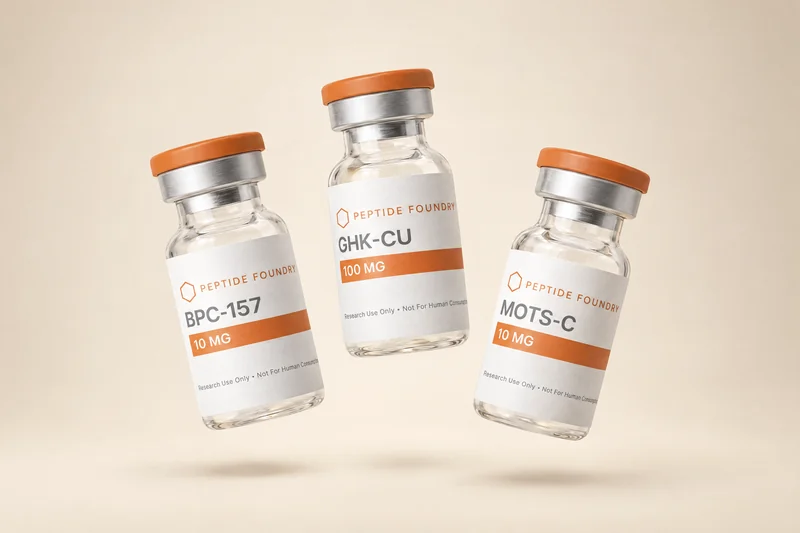
Plain-English 503A (patient-specific compounding) vs 503B (outsourcing facilities): separate bulks frameworks, and why RUO research catalogs are a different intended-use frame. Not legal advice.
Not legal advice. This Industry Watch article summarizes publicly available FDA materials (FD&C Act §§503A–503B literacy pages, eCFR, and related compounding guidance) for researchers who follow peptide-industry developments. It is not legal advice, regulatory counsel, or guidance on compounding, prescribing, importing, or marketing drugs. Peptide Foundry supplies research-use-only (RUO) materials for laboratory use by qualified researchers — not for human or veterinary use. For compliance questions, consult qualified counsel and primary FDA / eCFR sources.
Key points
- 503A addresses patient-specific compounding by state-licensed pharmacies/physicians under statutory conditions (not FDA outsourcing-facility registration).
- 503B addresses compounding by registered outsourcing facilities; current good manufacturing practice (CGMP) requirements continue to apply under that pathway.
- 503A and 503B use separate bulk-drug-substance frameworks — do not treat one list as the other.
- RUO research catalogs are not compounding pharmacies, prescriptions, or drug products under 503A/503B.
- Not legal advice. For July 2026 PCAC context on the 503A Bulks List, see the dated PCAC Industry Watch child.
Headlines about compounding often collapse two different FD&C Act pathways into one story. This Industry Watch literacy page contrasts Section 503A and Section 503B for researchers who need a calm, table-friendly reading of public FDA materials — without pharmacy playbooks or prescribing advice. It sits under the Peptide Industry Watch hub alongside dated children that freeze specific public-record moments.
What 503A and 503B are
Sections 503A and 503B of the Federal Food, Drug, and Cosmetic Act specifically address human drug compounding. FDA’s literacy chart, FD&C Act Provisions that Apply to Human Drug Compounding, summarizes which FD&C requirements still apply when products are compounded in accordance with each section’s conditions — and which exemptions may be available if those conditions are met. The chart is literacy, not a how-to. When compounding does not meet 503A or 503B conditions, FDA’s chart states that the drugs remain subject to the full set of FD&C requirements that apply to conventionally manufactured drugs.
Section 503A
Section 503A applies to human drug compounding by a licensed pharmacist in a state-licensed pharmacy or federal facility, or by a licensed physician, that is not registered with FDA as an outsourcing facility. Under FDA’s published contrast materials, compounding under 503A is framed around a valid prescription for an identified individual patient (with limited anticipation provisions described in statute and related FDA guidance). Exemptions FDA lists when 503A conditions are met include CGMP under section 501(a)(2)(B), labeling with adequate directions for use under section 502(f)(1), and new-drug approval requirements under section 505 — only if statutory conditions are satisfied.
Bulk-drug-substance conditions under 503A are their own framework (USP/NF monograph, component of an FDA-approved drug, or appearance on the 503A Bulks List developed through regulation, plus related interim Category policy while that list is developed). This page does not invent eligibility conclusions for any named peptide.
Section 503B
Section 503B applies to human drug compounding within an outsourcing facility. An outsourcing facility compounds by or under the direct supervision of a licensed pharmacist and must meet registration and reporting conditions in 503B(b). Unlike the 503A patient-specific frame, an outsourcing facility may or may not obtain prescriptions for identified individual patients.
FDA’s contrast chart is explicit on a point researchers often miss in mixed headlines: drugs compounded in accordance with 503B conditions are not exempt from CGMP under section 501(a)(2)(B). Exemptions FDA lists for 503B (when conditions are met) include labeling with adequate directions for use (502(f)(1)), new-drug approval requirements (505), and drug supply chain security requirements (582) — not a CGMP exemption. See also FDA’s Information for Outsourcing Facilities. Bulk substances under 503B follow a separate clinical-need / bulks framework — not 503A’s 21 CFR 216.23 pathway.
Contrast table
One-screen literacy contrast drawn from FDA’s public 503A/503B provisions chart. Not exhaustive; not a compliance checklist; not legal advice.
| Topic | 503A | 503B |
|---|---|---|
| Who | Licensed pharmacist in a state-licensed pharmacy or federal facility, or licensed physician — not registered as an outsourcing facility | Compounding by or under direct supervision of a licensed pharmacist in a registered outsourcing facility (facility need not be a licensed pharmacy) |
| Patient-specific Rx | Valid prescription for an identified individual patient (with limited anticipation described in statute/guidance) | May or may not obtain prescriptions for identified individual patients |
| CGMP (501(a)(2)(B)) | Exemption available if all 503A conditions are met (per FDA chart) | CGMP requirements continue to apply; not among the 503B exemptions FDA lists |
| FDA outsourcing registration | Not the outsourcing-facility pathway | Must comply with 503B registration and reporting conditions |
| Bulk drug substances | 503A bulks conditions / 503A Bulks List (codified at 21 CFR 216.23) + interim Category policy | Separate 503B bulks / clinical-need framework (and related shortage conditions described in statute) |
For the full statutory contrast — including “essentially a copy,” withdrawn/removed drugs, demonstrable difficulties, interstate limits under 503A, and 503B labeling/adverse-event conditions — use FDA’s FD&C Act provisions chart as the primary source.
Separate bulks lists
Researchers following peptide-industry headlines often treat “the bulks list” as one object. Under the FD&C Act literacy FDA publishes, 503A and 503B maintain separate bulk-drug-substance frameworks. Mixing them produces wrong conclusions about what any single meeting, Category PDF, or Federal Register notice changed.
Useful primary landing pages:
- Bulk Drug Substances Used in Compounding (FDA hub for 503A and 503B bulks materials)
- 21 CFR 216.23 — codified 503A Bulks List
- Interim Policy on Compounding Using Bulk Drug Substances Under Section 503A (guidance PDF)
Publish-day check (2026-09-16; eCFR title-21 issue date 2026-09-14): the codified list at 21 CFR 216.23 still names the same small set of mostly topical substances (Brilliant Blue G; Cantharidin; Diphenylcyclopropenone; N-acetyl-D-glucosamine; Squaric acid dibutyl ester; Thymol iodide) — no peptides. This page does not invent peptide additions. Re-open eCFR for the live section text rather than treating any Industry Watch snapshot as forever current. As §216.23 itself emphasizes, listing is not drug approval — presence on a bulks list (or on an interim Category evaluation) is not the same concept as FDA approval of a drug product. 503B bulks / clinical-need materials live on the same FDA bulks hub; treat them as adjacent threads — not automatic updates to the 503A codified list.
How this relates to July 2026 PCAC
The July 23–24, 2026 Pharmacy Compounding Advisory Committee meeting addressed nominations relevant to the 503A Bulks List pathway. PCAC is advisory: committee input is not an automatic amendment to 21 CFR 216.23, not automatic interim Category placement, and not drug approval. Final list placement, when it occurs, proceeds through FDA’s own evaluation and typically notice-and-comment rulemaking for the codified list.
This page does not rewrite the substance table from the dated PCAC child, invent vote tallies, or predict Category outcomes. For the meeting docket, agenda families, and advisory-vs-final stack as frozen for that update, read FDA PCAC July 2026: Peptide 503A Bulks List Review Explained (RUO). Use that child for the July 2026 moment; use this page for durable 503A vs 503B pathway literacy.
Compounding pathways vs RUO research materials
Bright line. Sections 503A and 503B address conditions under which pharmacies and outsourcing facilities may compound drug products for patients. Research-use-only peptide materials are supplied as laboratory research reagents labeled not for human or veterinary use. The frameworks are not interchangeable. Names that appear in compounding dockets may also appear on research catalogs as identity labels; that overlap is a naming fact, not a substitute pathway, prescription, or clinic access route.
Peptide Foundry’s Industry Watch position: track public policy literacy for researchers. We do not advise on compounding eligibility, prescriptions, clinic access, pharmacy selection, or “workarounds.” Soft literacy links (quality and claim literacy — not clinical use):
- USA research-peptide vendor criteria — claim vs proof checklist for suppliers
- How to read a research-peptide COA — lot match, named lab, HPLC vs MS
- ISO 5 cleanroom walkthrough — manufacturing-environment literacy
- cGMP claim literacy — what “cGMP compliant” can and cannot mean
- Peptide Industry Watch hub — series index and dated-update rules
- Research library index — full /research/ literacy catalog
Common questions
Is this page legal advice?
No. It summarizes publicly available FDA / eCFR materials for literacy. It is not legal advice, regulatory counsel, or guidance on compounding, prescribing, importing, or marketing drugs. Consult qualified counsel and primary FDA / eCFR sources for compliance questions.
Does this page explain how to compound peptides or find a compounding pharmacy?
No. Compounding playbooks, pharmacy finders, prescribing pathways, and “how to get around” guidance are out of scope. This page contrasts public statutory frameworks so researchers can read headlines accurately — not so they can operate a pharmacy pathway.
Do 503A and 503B use the same bulks list?
No. They use separate bulk-drug-substance frameworks. The codified 503A Bulks List is at 21 CFR 216.23; 503B has its own clinical-need / bulks materials. See FDA’s Bulk Drug Substances Used in Compounding hub and re-check eCFR.
Did the July 2026 PCAC meeting legalize peptides for compounding?
Not by itself. PCAC advice is an input to FDA’s decision-making — not automatic placement on 21 CFR 216.23, not drug approval, and not a substitute for reading current Category materials and the codified list. See the dated PCAC child. This is not legal advice.
Are Peptide Foundry materials for human use?
No. Research use only — not for human or veterinary use. Materials are supplied for in-vitro and laboratory research by qualified researchers. They are not compounded drugs under 503A or 503B.
Sources
- FD&C Act Provisions that Apply to Human Drug Compounding (FDA contrast chart)
- Bulk Drug Substances Used in Compounding
- 21 CFR 216.23 (codified 503A Bulks List)
- Information for Outsourcing Facilities
- Interim Policy on Compounding Using Bulk Drug Substances Under Section 503A (guidance PDF)
- Human Drug Compounding (FDA hub)
Return to Peptide Industry Watch. For the July 2026 503A Bulks List moment, continue to the PCAC dated child. For supplier and lot literacy, use the COA, vendor-criteria, cleanroom, and cGMP links above.
Not legal advice. This Industry Watch article is informational content for researchers. It does not constitute legal, regulatory, compounding, prescribing, or import guidance.
Research use only. Nothing on this page describes or implies use in humans or animals. Peptide Foundry materials are supplied for in-vitro and laboratory research by qualified researchers and for no other purpose. Compounding pathways under §§503A–503B are discussed here for public-record literacy only — not as clinical recommendations, pharmacy instructions, or product-use framing.
