
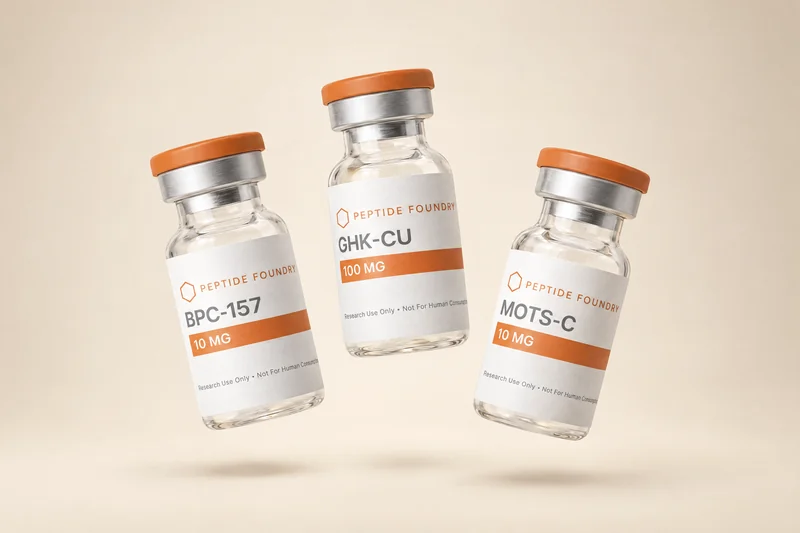
Epithalon (also spelled Epitalon) is the synthetic tetrapeptide Ala-Glu-Asp-Gly. Peptide Foundry identity anchors, naming/amidate literacy, and the purity panels to demand on a lot COA. Research use only.
- CAS Number
- 307297-39-8
- Molecular Formula
- C14H22N4O9 C14H22N4O9
- Molar Mass
- 390.35 g/mol
Epithalon — also commonly spelled Epitalon — is a synthetic tetrapeptide with the sequence Ala-Glu-Asp-Gly (AEDG). It is a discrete research material with its own CAS, formula, molar mass, and lot documentation — not a pineal extract synonym, not an amidate by default, and not a stand-in for every catalogue nickname that starts with “epi.”
If you found “epithalon,” “epitalon,” “epithalon coa,” “epithalon 50mg,” or “epithalon amidate coa” in a listing, the useful questions are which spelling maps to which molecule, whether the certificate describes free-acid or C-terminal amide form, and how the lot is documented. Aliases vary; registry fields and certificates do not.
This page covers Peptide Foundry’s published identity anchors, naming literacy (Epithalon vs Epitalon vs epithalamin; free acid vs amidate), the purity panels a research buyer should demand, and a worked Freedom Diagnostics lot — then soft-handoffs to the gated Epithalon research product page. Research use only.
Key points
- Epithalon = synthetic tetrapeptide Ala-Glu-Asp-Gly (AEDG); supplied as lyophilized research material (white powder on current Peptide Foundry lot documents).
- Peptide Foundry catalog anchors (live PDP): CAS 307297-39-8, formula C14H22N4O9, molar mass 390.35 g/mol, PubChem 219042 — match certificate fields to these claims.
- Epithalon / Epitalon / Epithalone are common spelling variants of the same synthetic tetrapeptide when CAS, formula, and sequence match; epithalamin is a pineal extract fraction historically studied — not certificate proof by itself.
- Demand a lot-matched COA: HPLC purity with method when stated, MS identity, named laboratory, and preferably independent portal verify; treat “amidate” listings as a terminus-form check against formula and mass.
- Research use only — not for human or veterinary use.
What is Epithalon?
Epithalon is a four-residue synthetic peptide: alanine–glutamic acid–aspartic acid–glycine (AEDG). Residue count is four (tetrapeptide). The research material on this page is the defined synthetic sequence, not a crude tissue extract.
A short historical note anchors naming only. Work associated with Khavinson and colleagues in the St. Petersburg Institute tradition described pineal peptide fractions (epithalamin), then studied defined synthetic sequences related to that line. That is origin history — not a product claim, not a catalogue mechanism story, and not registry proof.
Physical form on research listings is lyophilized solid. Peptide Foundry’s current lot documents describe white lyophilized powder under SKU PF-EPITHALON at a 50 mg size option. Appearance is a handling observation — not a purity proof and not a substitute for HPLC or MS identity.
Market aliases include Epithalon, Epitalon, Epithalone, AEDG, and informal “epi” shorthand (including “epi 50 peptide”). Aliases help search; they are not identity proof until you have CAS, formula, molar mass, sequence, and a lot-matched certificate.
Naming literacy: Epithalon, Epitalon, epithalamin, and amidate forms
Spelling variants
Epithalon, Epitalon, and Epithalone are the spelling variants you will see most often on research catalogues. When CAS 307297-39-8, formula C14H22N4O9, molar mass near 390.35 g/mol, and sequence Ala-Glu-Asp-Gly all agree, treat those spellings as market orthography for the same synthetic tetrapeptide. Peptide Foundry’s primary spelling is Epithalon; Epitalon is acknowledged because many searchers and papers use that form. Prefer registry fields over orthography debates.
Epithalamin extract vs synthetic AEDG
Epithalamin in historical literature typically refers to a pineal gland extract fraction — a complex material class studied as a fraction, not as a single four-residue synthetic. Epithalon is the synthetic Ala-Glu-Asp-Gly tetrapeptide designed as a defined research compound related to that research tradition.
Buyer checklist when a listing leans on pineal or “epithalamin” branding:
- Does the COA list sequence Ala-Glu-Asp-Gly?
- Does it publish CAS 307297-39-8 with formula C14H22N4O9 and mass near 390.35 g/mol?
- Does identity language (MS / HPLC) describe the tetrapeptide, not only an extract brand name?
Extract branding alone is not certificate proof. Origin history explains why both terms appear in literature indexes; it does not authorize consumer endocrine framing on a research catalogue page.
Free acid vs amidate (sourcing check)
Some vendors list Na-Epithalon-NH2, C-terminal amide, or “epithalon amidate” forms. An amidated C-terminus changes formula and mass relative to the free-acid tetrapeptide even when sellers reuse the same marketing name or, in some cases, cite the same CAS string.
Peptide Foundry publishes the free-acid formula C14H22N4O9 and molar mass 390.35 g/mol. At publish time Peptide Foundry does not list a separate amidate SKU. Queries such as “epithalon amidate coa” are answered here as literacy: read terminus form, formula, and mass on the certificate, then decide whether the vial matches the vendor’s published anchors.
Practical rule: match terminus form + formula + molar mass + sequence on the lot COA to the vendor’s chemistry table. Do not assume every “Epithalon” label is the free-acid form Peptide Foundry publishes, and do not invent a universal second CAS “winner” for amidate listings. That is a chemical-identity check for purchasing and documentation — keep it there.
Chemical identity anchors
Peptide Foundry publishes a fixed identity set for single-vial Epithalon. The values below match the live catalog chemistry table at the time of writing. Confirm against the current product page if a lot or chemistry block rotates after publish.
Sequence and composition
Sequence: Ala-Glu-Asp-Gly (L-alanyl-L-glutamyl-L-aspartyl-glycine). Residue count: 4 (tetrapeptide). SKU PF-EPITHALON; size option on the live listing at publish time: 50 mg lyophilized.
CAS, formula, and molar mass
| Field | Peptide Foundry catalog (live /product/epithalon/) |
|---|---|
| CAS | 307297-39-8 |
| Formula | C14H22N4O9 |
| Molar mass | 390.35 g/mol |
| PubChem CID | 219042 |
| Sequence | Ala-Glu-Asp-Gly (AEDG) |
| Residues | 4 |
| SKU | PF-EPITHALON |
| Form | Lyophilized |
| Size (live option) | 50 mg |
Market pages sometimes round mass to 390.3 Da, omit PubChem, or recycle CAS strings across terminus forms. The practical rule is: match the vendor’s stated CAS + formula + molar mass + sequence to the lot COA, then prefer orthogonal identity (MS) over the nickname alone.
What an Epithalon COA should show
A certificate of analysis is stronger when it is lot-specific, names the laboratory, states methods, and can be checked outside the supplier’s own site. For the full verification workflow — batch match, named lab, HPLC versus identity, biosafety panels, portal codes — see How to read a research-peptide COA.
Minimum research COA fields
- A lot / batch ID that matches the vial character for character
- Test or report date(s) and a named laboratory
- HPLC purity with method (and wavelength when stated)
- An identity method (MS and/or HPLC-RTM)
- Product name / sequence consistent with the label and the vendor’s published anchors
“Third-party tested” or “99%+” without a named lab and a lot number is an unfinished claim. A pretty PDF that cannot be tied to the vial in hand is documentation theater.
Stronger panels (when claimed)
When additional QC lines are present — the pattern on Peptide Foundry’s published Freedom Diagnostics Epithalon documentation — read them as separate analytical results:
- Mass-spectrometry identity confirmation
- Endotoxin (for example LAL) when claimed
- Appearance notes (for example white lyophilized powder) as handling observations only
- Net peptide content, sterility, or heavy metals when the certificate reports them
These describe composition and contamination panels for research documentation. They are not a safety-for-human-use claim, and they do not replace identity or purity.
Worked example — lot EPI50312
As published on the current Peptide Foundry Epithalon listing at the time of writing:
| Field | Value |
|---|---|
| Lot | EPI50312 |
| Size | 50 mg |
| Laboratory | Freedom Diagnostics |
| COA number | 2603130183 |
| Report date | 03/15/2026 |
| Purity | 99.29% (HPLC) |
| Identity | Mass spectrometry — confirmed |
| Appearance | White lyophilized powder |
| Test method | HPLC-UV / MS |
| Endotoxin | LAL verified |
Cite those figures as Peptide Foundry–published transparency for this lot — not a universal industry floor. Re-verify against the live product panel if the lot rotates after publish.
Freedom Diagnostics verify UX (COA-number path)
Unlike some ILS-tested Peptide Foundry lots that print a short alphanumeric access code, the Freedom Diagnostics panel for lot EPI50312 emphasizes a COA number (2603130183) plus an on-page Verify on Freedom Diagnostics path. Use the laboratory’s own flow with that COA number — not a reseller-only PDF host — and confirm compound, lot, purity, and report date match the document in hand.
Three steps that travel with any lot, not just EPI50312:
- Match the lot number on the vial to the lot on the certificate.
- Confirm CAS, formula, sequence, and labeled mass against the certificate and the product label — including free-acid versus amidate language if present.
- Verify on Freedom Diagnostics (or whichever named laboratory issued the report) using the published COA number / accession path — not only by opening a PDF hosted by the supplier.
A PDF on a supplier site is a document the supplier controls. A record you can pull from the testing laboratory is not. Portable vendor criteria beyond a single SKU: USA research-peptide vendor criteria.
Pathway-class literacy (preclinical / in vitro only)
Mechanism language is useful here only as classification of experimental systems in published literature. It does not establish catalogue-product outcomes in people, and it does not convert a citation into a certificate.
| Literature class (examples) | Acceptable framing on this page | Not used as product framing |
|---|---|---|
| Telomerase enzyme activity | Examined in preclinical and in-vitro publications exploring telomerase enzyme activity in cultured cell lines | Personal telomerase-activation claims; human telomere-length claims |
| Chromosomal telomere measurements | Studied in models measuring chromosomal telomere dynamics in cultured cell lines | Aging or lifespan claims as product benefits |
| Pineal peptide-fraction research history | Origin and naming literacy for epithalamin → synthetic AEDG | Consumer endocrine or pineal-replacement framing |
Keep pathway class attached to the source paper and the experimental system. Identity remains an analytical question answered by CAS, formula, sequence, and the lot COA.
Storage and lab handling (lyophilized)
Standard laboratory practice for lyophilized synthetic peptides applies:
- Storage. Sealed vials at −20°C, protected from light and moisture. Lyophilized material is substantially more stable than solution.
- Temperature excursions. Brief ambient exposure in transit is normal for lyophilized material. Return vials to −20°C on arrival.
- Freeze–thaw. Minimize repeated freeze–thaw.
- Traceability. Keep the lot number with the material — lot number ties a vial back to its certificate.
Assay-specific handling follows your institution’s SOPs. This page does not publish personal reconstitution protocols or solution-use schedules for Epithalon.
Common questions
Is Epithalon the same as Epitalon?
As market spelling variants for the synthetic AEDG tetrapeptide — yes, when CAS, formula, molar mass, and sequence match. Peptide Foundry catalogs the material as Epithalon. Prefer registry fields over orthography debates.
Is Epithalon the same as epithalamin?
No. Epithalamin typically names a pineal extract fraction in historical literature. Epithalon is the synthetic Ala-Glu-Asp-Gly tetrapeptide. Match sequence, CAS, formula, and the lot certificate — not extract branding alone.
What about “epithalon amidate”?
Other vendors may offer C-terminal amide or Na-Epithalon-NH2 forms. Those are different terminus presentations. Peptide Foundry publishes free-acid C14H22N4O9 / 390.35 g/mol and does not list a separate amidate SKU at publish time. Match formula and mass on the COA before treating any “Epithalon” label as interchangeable.
What makes an Epithalon COA usable?
Lot match to the vial, a named laboratory, HPLC purity with method when stated, mass-spectrometry (or equivalent) identity, and preferably an independent portal verify path. Worked EPI50312 figures above — Freedom Diagnostics, COA 2603130183, HPLC 99.29%, MS identity, LAL endotoxin verified — are an example of that pattern on Peptide Foundry’s live listing. Workflow detail: How to read a research-peptide COA.
Is this for human use, or for consumer aging or telomere claims?
No. Peptide Foundry supplies Epithalon strictly for laboratory and research use by qualified researchers. Mentions of telomerase enzyme activity or chromosomal telomere measurements in published preclinical and in-vitro literature are pathway-class context only — not product benefits and not human therapy. It is not a drug, supplement, cosmetic finished good, or veterinary product, and not for use in people or animals.
For the current lot certificate and product specifications, see the gated Epithalon research product page. Related library reading: How to read a research-peptide COA, USA research-peptide vendor criteria, Semax research identity, Lyophilized diluent literacy (BAC vs AA), NAD+ research identity, and GHK-Cu research identity.
Research use only. Nothing on this page describes or implies use in humans or animals. Pathway-class mentions of telomerase enzyme activity or telomere measurements refer only to preclinical and in-vitro literature contexts and are not product outcomes.
