
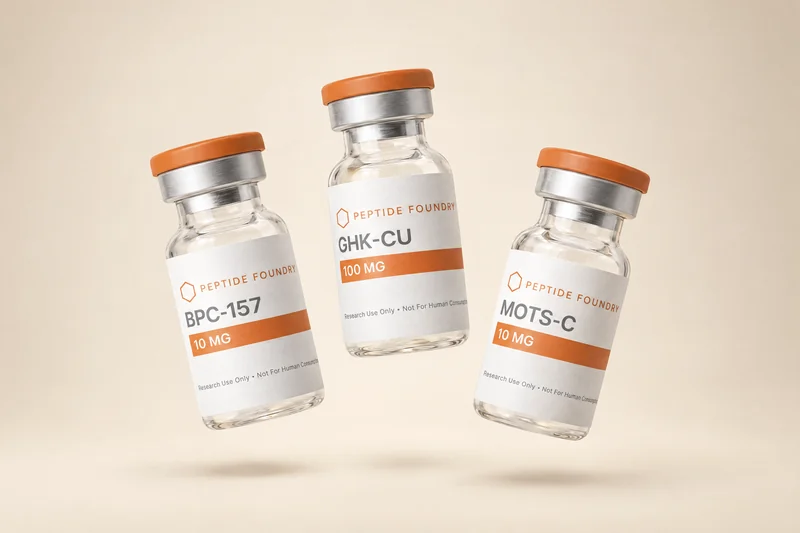
PEPTIDE FOUNDRY / UNDERSTANDING cGMP
What does cGMP
compliant mean?
It means following current Good Manufacturing Practice: a manufacturing system for controlling how products are made, checked and documented — not a single final test. Follow a batch to see what that means in practice.
Follow the batchAn illustrated guide to manufacturing controls. Representative spaces, not a tour of a specific facility.
ILLUSTRATIVE FACILITY · REPRESENTATIVE PROCESS

01 / 05 · Receiving
Know what enters.
Materials are identified, checked and held until approved for use. A record connects each input to its source.
The starting materials matter.

02 / 05 · Preparation
Ready before starting.
Written procedures guide the work. Equipment cleaning and maintenance records help establish that it is ready for the next operation.
Consistency begins before production.

03 / 05 · Production
Control the process.
Production follows approved instructions. Batch records capture the work performed; departures from instructions must be documented and justified.
A repeatable process leaves a record.

04 / 05 · Quality control
Check against a standard.
Laboratory results are compared with established specifications. Unexplained discrepancies and failures require investigation.
A test result needs context.

05 / 05 · Quality review
Review before release.
The quality unit reviews production and laboratory records before a batch is released or rejected. A passing result is only part of that decision.
Quality is a documented decision.
THE MEANING BEHIND THE LETTERS
Good practice.
Every step.
Current
Methods and systems must stay up to date — that is why FDA emphasizes the leading “c.”
Good
Quality is built into the work, not added at the end.
Manufacturing
The people, spaces and processes behind a product.
Practice
Controls put into action, consistently.
FDA describes cGMP as systems for the design, monitoring and control of manufacturing processes and facilities. Read the FDA overview →
TERMINOLOGY
cGMP vs GMP
Both labels point at manufacturing quality systems. The difference is mostly terminology and jurisdiction — not a ranking of “better” vendors.
“Current” Good Manufacturing Practice — systems expected to stay up to date.
Often shortened to GMP for the same quality-system idea outside FDA “cGMP” wording.
Neither equals FDA product approval. Neither equals an ISO 5 air class.
Educational comparison only. This page does not claim a specific inspection badge, auditor, or facility certificate ID beyond what Peptide Foundry already publishes elsewhere on the live site.
WHY IT MATTERS
More than
a final test.
Testing checks samples. Manufacturing controls address how the whole batch was made.
Prevent mistakes
Procedures and trained people help reduce mix-ups and contamination.
Make work traceable
Records connect materials, operations and results.
Learn from problems
Investigations help explain what went wrong and inform corrective action.
Peptide / RUO claim scope
For research peptides, a “cGMP-compliant facility” statement is process/facility language — it is not lot analytical proof and it does not convert an RUO research material into an approved drug. Still require a lot-matched Certificate of Analysis. See how to read a research-peptide COA and the USA research-peptide vendor criteria (Criterion 3 companion).
Walkthrough references: 21 CFR Part 211, including materials controls, production records and quality review. Requirements depend on the product and operation. Air classification is separate — ISO 5 cleanroom walkthrough.
QUESTIONS WORTH ASKING
Understand the claim.
Is cGMP the same as ISO 5?
No. ISO 5 describes an airborne-particle cleanliness class. cGMP addresses a broader manufacturing system, including personnel, procedures, equipment and records. Explore the ISO 5 walkthrough →
Is cGMP the same as GMP?
Mostly terminology. FDA commonly says cGMP to stress that practices must stay current. WHO, EU and PIC/S frameworks often say GMP for the same quality-system idea. Neither label equals product approval, and neither equals an ISO 5 air class. See the cGMP vs GMP section above.
Does “cGMP compliant” mean FDA approved?
No. A manufacturing compliance claim and product approval are different things. This educational walkthrough is not a certification or evidence of product approval. RUO research materials are not approved drugs.
What evidence should I look for?
Look for documentation relevant to the facility, its operations and the particular batch. Process or facility claims (including cGMP language) do not replace lot analytics — start with how to read a research-peptide COA, then check which tests a report includes, which lot it identifies and what the results actually establish. For how to weight manufacturing claims vs lot proof, use the USA research-peptide vendor criteria.
How to read a research-peptide COA · Explore peptides & batch reports
Peptide Foundry products are for laboratory research use only. This page explains manufacturing concepts; the illustrated route does not represent a verified facility layout.