


KLOW
Research Use Only · Not for Human Consumption
A four-peptide research blend of GHK-Cu, BPC-157, TB-500, and KPV supplied in lyophilized form.


Four-peptide research blend for tissue and cellular research applications
Blend Components
| Component | CAS# | Formula | Molar Mass |
|---|---|---|---|
| CAS Number: GHK-Cu | Molecular Formula: 49557-75-7 | Molar Mass: C14H22CuN6O4 | 401.91 g/mol |
| BPC-157 | 137525-51-0 | C62H98N16O22 | 1419.55 g/mol |
| TB-500 | 77591-33-4 | C212H350N56O78S | 4963.44 g/mol |
| KPV | 67727-97-3 | C16H30N4O4 | 342.43 g/mol |
What is KLOW?
KLOW is a multi-peptide research blend for studying tissue remodeling, cellular migration, collagen synthesis, and anti-inflammatory signaling pathways in vitro. It builds on the GLOW three-peptide combination—GHK-Cu, BPC-157, and TB-500—by adding KPV, the C-terminal tripeptide (Lys-Pro-Val) of alpha-MSH, to enable parallel investigation of extracellular matrix mechanisms and melanocortin-related signaling.
KLOW assembles four peptides that each entered the research literature along separate paths. GHK-Cu, a copper-binding tripeptide, was first described by Loren Pickart in the 1970s and has since been examined in vitro for associations with gene-expression and matrix-remodeling pathways. BPC-157 emerged in the early 1990s from Croatian researchers studying gastric protective fractions, while TB-500 (Thymosin Beta-4) traces to Allan Goldstein's thymosin work at the National Institutes of Health in the 1960s.
The fourth component, KPV, is the C-terminal tripeptide (Lys-Pro-Val) of alpha-melanocyte-stimulating hormone (alpha-MSH). It has been investigated in preclinical research for anti-inflammatory and melanocortin-related signaling pathways, including studies of intestinal epithelial cell models. KPV is what distinguishes KLOW from the three-peptide GLOW blend: KLOW pairs GLOW's extracellular-matrix-focused peptides with an additional tripeptide studied for distinct inflammatory-signaling mechanisms.
Combining the four peptides lets researchers examine complementary in-vitro mechanisms—matrix and collagen signaling, angiogenesis, cellular migration, and melanocortin-related inflammatory pathways—within a single lyophilized preparation. This product is intended for research use only.
How should KLOW be stored?
Peptide Foundry research peptides are supplied lyophilized (freeze-dried). Keep sealed vials cool, dry, and protected from light until reconstitution.
After reconstitution, refrigerate prepared solutions and use sterile technique. For general laboratory diluent and handling notes, see lyophilized peptide reconstitution.
Certificate of Analysis
Every batch of KLOW is tested by Freedom Diagnostics for purity, identity, heavy metals, microbial contamination, and endotoxin. The full certificate is below.
KLOW · 50mg/10mg/10mg/10mg
Purity · HPLC-UV
99.40% purity
Area-normalized against all peptide-related peaks. Identity confirmed by chromatographic retention-time match to a reference standard.
Every test on this certificate
COA documents are updated with each new batch. Contact support for batch-specific documentation.
Compare research materials
GHK-Cu, GLOW and KLOW: what’s in each vial?
Compare the standalone material with the blends by named components and labeled amounts. The amounts below describe vial contents, not preparation instructions.
Related material
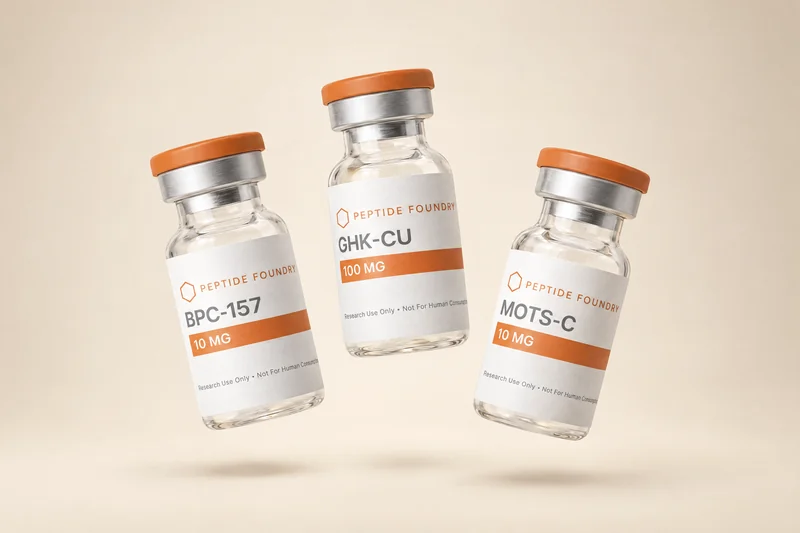
GHK-CU
- GHK-CU
- 100 mg
Related material
GLOW
- GHK-Cu
- 50 mg
- BPC-157
- 10 mg
- TB-500
- 10 mg
This product
KLOW
- GHK-Cu
- 50 mg
- BPC-157
- 10 mg
- TB-500
- 10 mg
- KPV
- 10 mg
For blend composition and documentation checks, read GLOW vs KLOW and how to read a multi-peptide blend COA. All materials are for laboratory research only.
Further reading
References
- Pickart L, Margolina A. Regenerative and protective actions of the GHK-Cu peptide in the light of the new gene data. Int J Mol Sci. 2018;19(7):1987.
- Pickart L, Vasquez-Soltero JM, Margolina A. GHK peptide as a natural modulator of multiple cellular pathways in skin regeneration. Biomed Res Int. 2015;2015:648108.
- Sosne G, Qiu P, Goldstein AL, Wheater M. Biological activities of thymosin beta4 defined by active sites in short peptide sequences. FASEB J. 2010;24(7):2144-2151.
- Goldstein AL, Hannappel E, Sosne G, Kleinman HK. Thymosin beta4: a multi-functional regenerative peptide. Basic properties and clinical applications. Expert Opin Biol Ther. 2012;12(1):37-51.
- Sikiric P, Seiwerth S, Rucman R, et al. Stable gastric pentadecapeptide BPC 157: novel therapy in gastrointestinal tract. Curr Pharm Des. 2011;17(16):1612-1632.
- Dalmasso G, Charrier-Hisamuddin L, Nguyen HT, et al. PepT1-mediated tripeptide KPV uptake reduces intestinal inflammation. Gastroenterology. 2008;134(1):166-178.
