
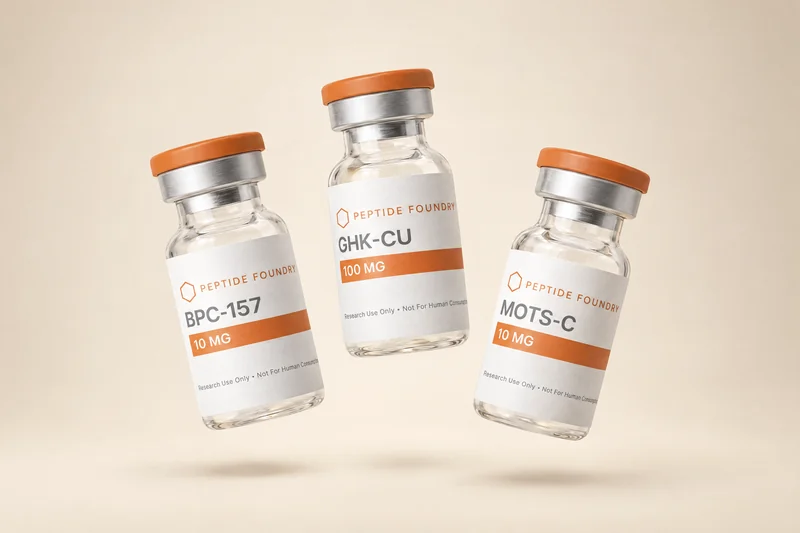
PT-141 is a synthetic cyclic heptapeptide from α-MSH (CAS 189691-06-3). Formula/mass anchors and lot COA purity panels. Research use only.
PT-141 is a synthetic cyclic heptapeptide derived from alpha-melanocyte-stimulating hormone (α-MSH). It is a discrete research material with its own CAS, formula, molar mass, and lot documentation — not a catalogue nickname for every “bremelanotide” listing, and not a synonym for related melanocortin-family research SKUs treated as consumer drugs.
If you found “pt-141,” “pt 141,” “bremelanotide,” “pt-141 research peptide,” “pt-141 coa,” or “pt-141 third party tested” in a listing, the useful questions are which registry fields the seller claims, whether the certificate matches those anchors, and how the vial lot is documented. Aliases vary; registry fields and certificates do not.
This page covers Peptide Foundry’s published identity anchors, listing-name literacy for the Bremelanotide alias, the purity panels a research buyer should demand, and a worked Freedom Diagnostics lot for the live 10 mg option — then soft-handoffs to the PT-141 research product page. Research use only.
Key points
- PT-141 = synthetic cyclic heptapeptide derived from α-MSH; supplied as lyophilized research material. Listing alias Bremelanotide = naming literacy only — not a drug-benefit claim.
- Peptide Foundry catalog anchors (live PDP): CAS 189691-06-3, formula C50H68N14O10, molar mass 1025.2 g/mol — match certificate fields to these claims. A letter sequence is not listed on the live PDP and is not invented here.
- SKU
PF-PT-141; live size option 10 mg lyophilized — match each vial to its own lot certificate (current worked example = PT312 / Freedom Diagnostics).- Demand a lot-matched COA: HPLC purity with method when stated, identity method, named laboratory, and downloadable lot documentation; “third-party tested” or “high purity” without lot + named lab is unfinished.
- Research use only — not for human or veterinary use; not a sexual-health, wellness, libido, arousal, erectile, desire, or consumer drug product.
What is PT-141?
PT-141 is a synthetic cyclic heptapeptide derived from alpha-melanocyte-stimulating hormone (α-MSH). The research material on this page is that defined analog class with the published registry anchors below — not a crude tissue extract and not a brand stack.
A short historical note anchors naming only. Melanocortin analog research associated with the University of Arizona described PT-141 as a structural modification of Melanotan 2 with altered receptor selectivity in published preclinical literature. That is origin and tool-compound / naming history — not a catalogue mechanism claim, not registry proof, and not a consumer-drug story.
Physical form on research listings is lyophilized solid (white powder on the current certificate). Peptide Foundry’s current catalog documents describe lyophilized material under SKU PF-PT-141 at a 10 mg size option. Appearance is a handling observation — not a purity proof and not a substitute for HPLC or identity data on a certificate.
Market aliases include PT-141, PT 141, and Bremelanotide. Aliases help search and inventory. They are not identity proof until you have CAS, formula, molar mass, cyclic heptapeptide / α-MSH-derived framing, and a lot-matched certificate. Bremelanotide as a listing name is naming literacy only — it is not a drug-as-benefit claim on this RUO page. The live Peptide Foundry PDP does not publish a one-letter sequence; this page follows that publication set and does not invent one.
Chemical identity anchors
Peptide Foundry publishes a fixed identity set for single-vial PT-141. The values below match the live catalog chemistry table at the time of writing. Confirm against the current product page if a lot or chemistry block rotates after publish.
Naming and class
Class: synthetic cyclic heptapeptide derived from α-MSH; melanocortin-receptor research tool compound (literature class). Listing alias: Bremelanotide (naming only). SKU PF-PT-141; size option on the live listing at publish time: 10 mg lyophilized.
CAS, formula, and molar mass
| Field | Peptide Foundry catalog (live /product/pt-141/) |
|---|---|
| CAS | 189691-06-3 |
| Formula | C50H68N14O10 |
| Molar mass | 1025.2 g/mol |
| Length / class | Cyclic heptapeptide derived from α-MSH |
| Listing alias | Bremelanotide (naming only — not drug-as-benefit) |
| SKU | PF-PT-141 |
| Form | Lyophilized |
| Size (live option) | 10 mg |
Market pages sometimes round mass differently or recycle CAS strings across unrelated melanocortin nicknames. The practical rule is: match the vendor’s stated CAS + formula + molar mass + analog framing to the lot COA, then prefer orthogonal identity (MS / HPLC) over the nickname alone.
What a PT-141 COA should show
A certificate of analysis is stronger when it is lot-specific, names the laboratory, states methods, and can be checked via downloadable lot documentation or the issuing laboratory’s verification workflow. For the full verification workflow — batch match, named lab, HPLC versus identity, biosafety panels — see How to read a research-peptide COA.
Minimum research COA fields
- A lot / batch ID that matches the vial character for character
- Test or report date(s) and a named laboratory
- HPLC purity with method (and wavelength when stated)
- An identity method (MS and/or HPLC-RTM)
- Product name / composition consistent with the label and the vendor’s published anchors
“Third-party tested,” “high purity PT-141,” or “99% pure” without a named lab and a lot number is an unfinished claim. Do not round a reported HPLC figure such as 99.872% when citing a certificate.
Stronger panels (when claimed)
- Mass-spectrometry or HPLC identity confirmation
- Net peptide content versus labeled mass when reported
- Endotoxin (for example LAL / USP <85>)
- Sterility / no growth, heavy metals, and illicit screens when claimed
These describe composition and contamination panels for research documentation. They are not a safety-for-human-use claim.
Worked example — lot PT312 (10 mg)
As published on the current Peptide Foundry PT-141 listing at the time of writing for the 10 mg option:
| Field | Value |
|---|---|
| Lot | PT312 |
| Size | 10 mg |
| Laboratory | Freedom Diagnostics |
| Report date | 03/15/2026 |
| Purity | 99.872% (HPLC) |
| Net peptide content | 9.09 mg |
| Identity | Mass Spectrometry — confirmed |
| Test method | HPLC-UV / Mass Spectrometry |
| LAL endotoxin | Verified |
| Appearance | White Lyophilized Powder |
| COA number | 2603130191 |
Cite those figures as Peptide Foundry–published transparency for this lot — not a universal industry floor. Re-verify against the live product panel if the lot rotates after publish. The live PDP publishes downloadable Full COA and Endotoxin Test PDFs for this batch.
Three steps that travel with any lot, not just PT312:
- Match the lot number on the vial to the lot on the certificate.
- Confirm CAS, formula, and labeled mass against the certificate and the product label.
- Open the downloadable lot PDF and confirm the named-lab fields. The live Peptide Foundry PT-141 listing links “Verify on Freedom Diagnostics” to the Freedom Diagnostics homepage (
https://freedomdiagnosticstesting.com). No lot-specific portal access code is published on the live PDP — do not invent one; teach lot → PDF → named lab matching.
Portable vendor criteria beyond a single SKU: USA research-peptide vendor criteria.
Related research peers (soft handoffs)
Research catalogues sometimes co-browse melanocortin-family materials beside PT-141 listings. Co-browsing is inventory adjacency — not a synonym set and not a protocol for combining materials.
- How to read a research-peptide COA and USA research-peptide vendor criteria — same trust workflow.
- Lyophilized peptide reconstitution — general lab diluent literacy without PT-141 schedules.
- Optional soft melanocortin-family identity peer: Melanotan 2 research identity — chemical/class sibling only; never equal dual-CTA and never a stack recommendation.
Match each vial to its own registry fields and lot certificate. Shared catalogue adjacency is literacy — not a stack recommendation.
Tool-compound / naming literacy (preclinical framing only)
Receptor-subtype language is useful here only as classification of experimental systems in published literature. It does not establish catalogue-product outcomes in people, and it does not convert a citation into a certificate. Keep this section shorter than identity and COA literacy.
| Literature / naming class | Acceptable framing on this page | Not used as product framing |
|---|---|---|
| Cyclic heptapeptide derived from α-MSH | Listing name PT-141 / Bremelanotide refers to a published synthetic cyclic heptapeptide α-MSH-derived class | Sexual-health, libido, arousal, erectile, or desire product claims |
| Melanocortin receptor interactions in cell-culture / preclinical models | Examined in preclinical publications as a tool compound interacting with melanocortin receptor subtypes in experimental systems | Bremelanotide-as-drug benefit, compounding-pharmacy, or consumer treatment framing |
| Structural relationship to Melanotan 2 in literature | Described in published work as a structural modification relative to Melanotan 2 (naming / history only) | Stack protocols or dual-CTA sexual outcomes |
Therapeutic and sexual-health titles that dominate wider SERPs sit outside the scope of this RUO identity page and are not summarized as product use. Identity remains an analytical question answered by CAS, formula, analog framing, and the lot COA.
Storage and lab handling (lyophilized)
Standard laboratory practice for lyophilized synthetic peptides applies:
- Storage. Sealed vials at −20°C, protected from light and moisture. Lyophilized material is substantially more stable than solution.
- Temperature excursions. Brief ambient exposure in transit is normal for lyophilized material. Return vials to −20°C on arrival.
- Freeze–thaw. Minimize repeated freeze–thaw.
- Traceability. Keep the lot number with the material — lot number ties a vial back to its certificate.
Assay-specific handling follows your institution’s SOPs. This page does not publish personal reconstitution schedules, nasal protocols, or solution-use protocols for PT-141. General lyophilized-material diluent literacy (without compound-specific schedules) lives at Lyophilized peptide reconstitution.
Common questions
What is PT-141’s CAS, formula, and mass?
CAS 189691-06-3; formula C50H68N14O10; molar mass 1025.2 g/mol; synthetic cyclic heptapeptide derived from α-MSH. Peptide Foundry catalogs the material as SKU PF-PT-141 (10 mg lyophilized option at publish time). The live PDP does not publish a letter amino-acid sequence; prefer registry fields over listing nicknames.
Is PT-141 the same as Bremelanotide?
Bremelanotide is a common listing alias for this cyclic heptapeptide α-MSH-derived class when CAS, formula, molar mass, and the lot certificate agree. Styling is not a second compound. On this RUO page, Bremelanotide is naming literacy only — not a drug-as-benefit claim. Match registry fields and the vial lot.
What makes a PT-141 COA usable — and what does “third-party tested” require?
Lot match to the vial, a named laboratory, HPLC purity with method when stated, an identity method (MS and/or HPLC), and downloadable lot documentation (or another confirmable verify path). Stronger documentation adds net peptide content and endotoxin when claimed. Worked PT312 figures above — Freedom Diagnostics, HPLC 99.872%, MS identity confirmed, net 9.09 mg, COA number 2603130191 — are an example of that pattern on Peptide Foundry’s live listing. The live PDP does not publish a lot-specific portal access code; use the downloadable PDFs and the named-lab verify link as presented. Workflow detail: How to read a research-peptide COA.
Is this for sexual health, libido, arousal, erectile use, or human use?
No. Peptide Foundry supplies PT-141 strictly for laboratory and research use by qualified researchers. Mentions of melanocortin receptor interactions or Melanotan 2 structural origin in published preclinical literature are tool-compound / literature-class context only — not product benefits and not human therapy. This page does not describe consumer finished goods, personal-use schedules, nasal or injection protocols, or stack recommendations. PT-141 here is not a drug, supplement, consumer finished good, or veterinary product, and not for use in people or animals.
For the current lot certificate and product specifications, see the PT-141 research product page. Related library reading: How to read a research-peptide COA, USA research-peptide vendor criteria, Lyophilized peptide reconstitution, and Melanotan 2 research identity.
Research use only. Nothing on this page describes or implies use in humans or animals. Tool-compound mentions of melanocortin receptor interactions or Melanotan 2 structural origin refer only to preclinical literature contexts and are not product outcomes.
