
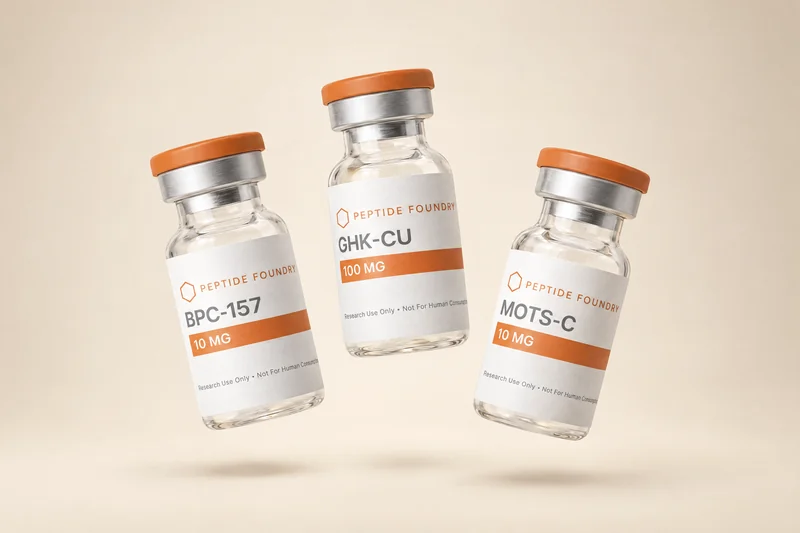
GLOW is GHK-Cu + BPC-157 + TB-500; KLOW adds KPV. Compare Peptide Foundry’s published mass ratios, CAS anchors, and when a 3- vs 4-component research blend fits. Research use only.
GLOW and KLOW are market labels for co-lyophilized multi-peptide research materials, not single CAS-registered molecules. Both share a three-peptide core — GHK-Cu, BPC-157, and TB-500. KLOW adds a fourth component, KPV (Lys-Pro-Val).
If you landed on “glow vs klow,” “klow vs glow,” or “klow peptide blend” while comparing catalogue listings, the useful questions are which components are present, what mass of each is labeled, how vendors can reuse the same marketing name at different mass splits, and how to match each lot to a third-party certificate. Listing rhyme is not identity. Registry fields and lot records are.
This page compares Peptide Foundry’s published mass ratios for both blends, anchors every component CAS (including KPV), teaches ratio literacy with a factual competitor-split example, and frames three- versus four-component choice as a research-reagent variable-count decision — then soft-handoffs to the gated GLOW and KLOW product pages.
Key points
- Both GLOW and KLOW are blend labels, not single CAS substances.
- Shared core: GHK-Cu + BPC-157 + TB-500 at Peptide Foundry’s fixed masses.
- KLOW only: KPV (Lys-Pro-Val), CAS 67727-97-3.
- Peptide Foundry conventions: GLOW
50mg/10mg/10mg(70 mg total); KLOW50mg/10mg/10mg/10mg(80 mg total).- Research use only — not for human or veterinary use.
What do “GLOW” and “KLOW” mean?
They are catalogue and market labels, not chemical names. No naming authority — IUPAC, CAS, or WHO — registers “GLOW” or “KLOW” as a substance. Each resolves only as a vendor shorthand for a co-lyophilized multi-peptide preparation whose identity lives in the component list, the labeled milligrams, and the lot certificate.
Mnemonic literacy helps inventory more than chemistry. KLOW’s leading “K” is commonly read as a pointer to KPV in supplier copy. GLOW’s letters do not map one-to-one to the three component initials. Never infer composition from the acronym alone. Two vendors can both sell “GLOW” (or both sell “KLOW”) with different mass splits under the same marketing word. Compare labeled milligrams and certificates — not the rhyme.
In Peptide Foundry’s catalog, the relationship is explicit: GLOW is the three-component co-lyophilized blend; KLOW is the same three masses plus KPV. That is a Peptide Foundry catalogue convention documented on the live product panels. Other sellers may use the same words differently. Treat every listing the way you would treat any other vendor shorthand: useful for search and inventory until you have component CAS numbers, labeled masses, and a lot-matched COA.
Side-by-side composition (Peptide Foundry catalog)
The tables below match Peptide Foundry’s live gated product panels at the time of writing: SKU PF-GLOW size 50mg/10mg/10mg, and SKU PF-KLOW size 50mg/10mg/10mg/10mg. Confirm against the current product pages if a size attribute or lot panel rotates after publish.
Component presence
| Component | GLOW (PF) | KLOW (PF) |
|---|---|---|
| GHK-Cu | Yes — 50 mg | Yes — 50 mg |
| BPC-157 | Yes — 10 mg | Yes — 10 mg |
| TB-500 | Yes — 10 mg | Yes — 10 mg |
| KPV | No | Yes — 10 mg |
| Labeled total | 70 mg (50mg/10mg/10mg) |
80 mg (50mg/10mg/10mg/10mg) |
| Component count | 3 | 4 |
Mass order on a size string does not always match the order of names on a COA header. Peptide Foundry’s GLOW convention maps 50 / 10 / 10 to GHK-Cu / BPC-157 / TB-500. KLOW maps 50 / 10 / 10 / 10 to the same three plus KPV 10 mg. When a certificate title lists components in a different sequence (for example GHK-Cu / TB-500 / BPC-157 / KPV), read the masses next to the named components rather than assuming left-to-right label order equals left-to-right certificate order.
Per-component identity anchors
Each component is a separately registered research material. The blend names are not. Values below match Peptide Foundry’s catalog chemistry tables and the live blend panels.
| Component | CAS# | Formula | Molar mass |
|---|---|---|---|
| GHK-Cu | 49557-75-7 | C14H22CuN6O4 | 401.91 g/mol |
| BPC-157 | 137525-51-0 | C62H98N16O22 | 1419.55 g/mol |
| TB-500 | 77591-33-4 | C212H350N56O78S | 4963.44 g/mol |
| KPV | 67727-97-3 | C16H30N4O4 | 342.43 g/mol |
Mass ratio is not molar ratio. The four molar masses span more than an order of magnitude (roughly 342 to 4,963 g/mol), so equal milligram amounts are not equal molar amounts. For assay math, convert with the molar masses above rather than treating the milligram label as stoichiometric. Some market listings publish an alternate GHK-Cu CAS (for example 89030-95-5); Peptide Foundry publishes 49557-75-7 with formula C14H22CuN6O4 and molar mass 401.91 g/mol on the live catalog. Match formula + mass + lot COA, not the nickname alone. For single-component GHK-Cu identity depth, see GHK-Cu research identity.
What does KPV add chemically?
KPV is the tripeptide Lys-Pro-Val (lysyl-prolyl-valine). It is registered as CAS 67727-97-3, formula C16H30N4O4, molar mass 342.43 g/mol. Supplier and literature language often describes it as the C-terminal tripeptide fragment of α-melanocyte-stimulating hormone (α-MSH). That is a sequence-class identification fact — three residues at the C-terminus of a longer peptide hormone class — not a product claim for either blend.
Preclinical literature discusses KPV in pathway contexts that include peptide transporter PepT1 and NF-κB–related signaling as research pathway classes. Those citations classify where the molecule appears in published experimental literature. They are not efficacy claims for a co-lyophilized market blend, and this page does not translate pathway-class language into outcome language for GLOW, KLOW, or KPV alone.
From a research-reagent perspective, adding KPV to a co-lyophilized vial adds a fourth analytical and experimental variable: another analyte in the same solid cake, another peak set to account for in chromatography, another identity field to match on documentation, and another degree of freedom when attributing results after co-dissolution. That is logistics and design complexity — not an “upgrade” ranking over the three-component material. Neither blend is more advanced; combined-formulation clinical data for either market label as a unit is not the point of this page. Identity and documentation are.
Ratio literacy: why “GLOW” is not one formula
Peptide Foundry’s fixed GLOW convention is GHK-Cu 50 mg / BPC-157 10 mg / TB-500 10 mg — label 50mg/10mg/10mg, 70 mg total labeled peptide content. KLOW extends that convention with KPV 10 mg — label 50mg/10mg/10mg/10mg, 80 mg total. Those are catalogue mass labels, not registry standards and not molar ratios.
Other vendors can publish different splits under the same marketing name. A factual example: Oath Research has published a GLOW 50 mg presentation as 5 mg BPC / 10 mg TB / 35 mg GHK (alongside other total-mass presentations in the wider market). That contrast is useful only as comparison literacy — same storefront word, different labeled milligrams. Compare certificates and labels, not acronyms. This page does not invent purity grades, quality rankings, or motives for any competitor’s split.
Secondary blogs sometimes write “5:1:1” as shorthand for a 50/10/10 mass description. That shorthand is a rough mass description of one vendor convention, not a CAS-level definition and not a guarantee that every “GLOW” vial on the open web matches it. Market totals of 70 mg versus 80 mg likewise track labeled component sums when the fourth component is present; they are not independent brand grades. Always read the component↔mass mapping on the vial and the certificate in hand.
When is a 3- vs 4-component blend the right research reagent?
Frame the choice as assay design, inventory logistics, and variable count — not as a personal preference ranking between market names. The table below uses Peptide Foundry’s published conventions as the reference stoichiometry.
| Research-reagent need | Lean GLOW (3) | Lean KLOW (4) |
|---|---|---|
| Fixed co-lyophilized GHK-Cu + BPC-157 + TB-500 stoichiometry | Yes | Yes (same three masses in PF convention) |
| Need KPV in the same co-lyophilized preparation | No — source KPV separately or choose KLOW | Yes |
| Minimize number of co-dissolved analytes / simplify attribution | Prefer 3-component | Accept 4th variable |
| Independent concentration control of each peptide | Prefer separate singles (or singles + one blend) — logistics only | Same caveat |
Choose the three-component GLOW reagent when the design needs the fixed GHK-Cu / BPC-157 / TB-500 mass stoichiometry without a co-dissolved fourth analyte. Choose the four-component KLOW reagent when the design specifically requires KPV in the same co-lyophilized preparation. More components means more variables in attribution and documentation; “more peptides” is not automatically better for every workflow.
Separate single-component vials remain appropriate when independent concentration control matters. Singles versus blend is an inventory and vial-count tradeoff: one vial fixes stoichiometry and reduces vial count; multiple vials preserve independent control. That is logistics, not a protocol. How you prepare solutions for a specific assay belongs to your institution’s SOPs, not to a supplier article. For GLOW-only identity depth, see What is the GLOW research blend?.
How do you verify GLOW and KLOW lot COAs?
Most suppliers publish a purity specification. A certificate of analysis is stronger when it is lot-specific, names the laboratory, and can be checked outside the supplier’s own site. Multi-peptide blends add one more requirement: the certificate (or accompanying blend panel) should make the component list and labeled masses unambiguous. For the full verification workflow — batch match, named lab, HPLC versus identity, biosafety panels, portal codes — see How to read a research-peptide COA.
Blend COA expectations
- A lot / batch ID that matches the vial character for character.
- A named laboratory and test date(s).
- Clear component list and labeled masses (three for GLOW; four for KLOW), or identity data that can be tied to them.
- HPLC purity with method and wavelength (for example 214 nm).
- An identity method (MS and/or HPLC-RTM).
- Net peptide content versus labeled total mass when reported.
- Where claimed: heavy metals, sterility, endotoxin, and illicit-substance screens as separate analytical results.
A red flag is a single “blend purity %” with no lot number, no laboratory name, no component attribution, and no way to confirm the document exists outside the seller’s PDF host. “Third-party tested” without a named lab and a lot number is an unfinished claim.
Worked example — GLOW lot FO996
As published on the current Peptide Foundry GLOW listing (SKU PF-GLOW) at the time of writing:
| Field | Value |
|---|---|
| Lot | FO996 |
| Size | 50mg/10mg/10mg |
| Laboratory | ILS Laboratories |
| Purity | 99.65% (HPLC @ 214 nm) |
| Net peptide content | 73.89 mg |
| Access code | QY5NMBMV |
Worked example — KLOW lot FO993
As published on the current Peptide Foundry KLOW listing (SKU PF-KLOW) at the time of writing:
| Field | Value |
|---|---|
| Lot | FO993 |
| Size | 50mg/10mg/10mg/10mg |
| Laboratory | ILS Laboratories |
| Purity | 99.61% (HPLC @ 214 nm) |
| Net peptide content | 82.4 mg |
| Access code | RATK8CGX |
Three steps that travel with any lot, not just these two:
- Match the lot number on the vial to the lot on the certificate.
- Confirm the component list and labeled masses against the certificate and the product label (three masses for GLOW; four for KLOW).
- Verify the access code on the issuing laboratory’s own portal when one is provided — not only by opening a PDF hosted by the supplier.
That last distinction matters. A PDF on a supplier site is a document the supplier controls. A record you can pull from the testing laboratory is not. When evaluating any supplier in this category, independent verification is the question worth asking. Prefer the certificate that matches the lot in hand if older archive certificates also exist for the same SKU.
Storage and lab handling (lyophilized)
Standard laboratory practice for lyophilized synthetic peptides applies to three- and four-component co-lyophilized vials alike:
- Storage. Sealed vials at −20°C, protected from light and moisture. Lyophilized material is substantially more stable than solution.
- Temperature excursions. Brief ambient exposure in transit is normal for lyophilized material. Return vials to −20°C on arrival.
- Freeze–thaw. Minimize repeated freeze–thaw. Storage stability and handling frequency are separate facts on a certificate for a reason.
- Traceability. Keep the lot number with the material. Lot number is what ties a vial back to its certificate; material separated from its lot number cannot be traced to any analysis.
Specifics beyond lyophilized storage depend on your assay and your institution’s standard operating procedures, which take precedence over any supplier guidance.
Common questions
Is KLOW just GLOW with KPV?
In Peptide Foundry’s catalog, yes: KLOW uses the same three masses as GLOW (GHK-Cu 50 mg, BPC-157 10 mg, TB-500 10 mg) and adds KPV 10 mg. Other vendors may define either label differently — read the labeled milligrams on the listing you are evaluating.
Is either blend a single molecule?
No. Neither GLOW nor KLOW has a single CAS registry entry as a substance. Identity is the component CAS numbers plus the labeled mass of each component in the vial.
Why do totals say 70 mg versus 80 mg?
Those totals are the sums of labeled component masses. Peptide Foundry’s GLOW sums to 50 + 10 + 10 = 70 mg; KLOW sums to 50 + 10 + 10 + 10 = 80 mg. Net peptide content on a COA can differ from the labeled sum; that is a measured field, not a contradiction of the size label.
Can vendors disagree on GLOW ratios?
Yes. Marketing names are not registry standards. Peptide Foundry publishes 50/10/10 for GLOW; other sellers have published different splits under the same word (for example a 50 mg presentation as 5/10/35). Compare certificates, not acronyms.
When should a lab choose three components versus four?
Choose GLOW when the assay design needs the fixed three-peptide stoichiometry without a co-dissolved fourth analyte. Choose KLOW when the design specifically requires KPV in the same co-lyophilized preparation. Prefer separate singles when independent concentration control of each peptide matters. More components is not automatically better.
Are GLOW or KLOW for human use?
No. Peptide Foundry supplies both blends strictly for laboratory and research use by qualified researchers. They are not drugs, not supplements, and not veterinary products. They are not for use in people or animals.
For current lot certificates and product specifications, see the gated GLOW research product page and the gated KLOW research product page. Related library reading: What is the GLOW research blend?, What is the KLOW research blend?, BPC-157 vs TB-500, How to read a research-peptide COA, GHK-Cu research identity, Multi-peptide blend COA, and What is GLP-3RT?.
Research use only. Nothing on this page describes or implies use in humans or animals.
