

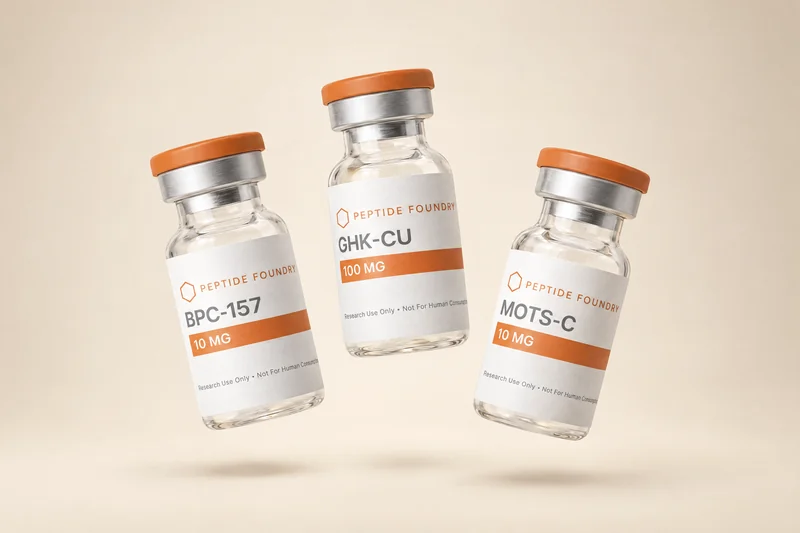

AOD-9604
Research Use Only · Not for Human Consumption
A synthetic 16-amino-acid fragment corresponding to residues 176–191 of the C-terminus of human growth hormone


A synthetic fragment of human growth hormone (residues 176–191)
Chemistry
| CAS# | Formula | Molar Mass |
|---|---|---|
| CAS Number: 221231-10-3 | Molecular Formula: C78H123N23O23S2 | Molar Mass: 1815.08 g/mol |
What is AOD-9604?
AOD-9604 is a synthetic fragment of the C-terminus of human growth hormone (HGH), corresponding to amino acids 176–191. It has been examined in preclinical models for interactions with lipolytic signaling pathways distinct from the glycemic and growth-promoting pathways associated with full-length HGH.
AOD-9604 was developed in the late 1990s at Monash University in Australia. Researchers there were investigating whether a fragment of the growth hormone molecule could retain lipolytic signaling activity in adipocyte models without the glycemic and proliferative effects of the full-length protein.
The team identified that amino acids 176 to 191 of the growth hormone sequence exhibited lipolytic signaling in adipose tissue models without activating insulin or IGF-1-related growth pathways. They designated this fragment AOD-9604.
AOD-9604 has appeared in peer-reviewed preclinical publications examining growth-hormone fragment biology and adipocyte signaling since the early 2000s. This product is intended for research use only.
How should AOD-9604 be stored?
Peptide Foundry research peptides are supplied lyophilized (freeze-dried). Keep sealed vials cool, dry, and protected from light until reconstitution.
After reconstitution, refrigerate prepared solutions and use sterile technique. For general laboratory diluent and handling notes, see lyophilized peptide reconstitution.
Certificate of Analysis
Every batch of AOD-9604 is tested by ILS Laboratories, an ISO/IEC 17025–accredited lab, for purity, identity, heavy metals, sterility, endotoxin, and a fentanyl screen. The full certificate is below.
AOD-9604 · 5mg
Peptide Purity · HPLC @ 214 nm
99.49% — exceptional research-grade purity
Area-normalized against all peptide-related peaks. Identity confirmed by chromatographic retention-time match to a reference standard.
Every test on this certificate
COA documents are updated with each new batch. Contact support for batch-specific documentation.
Related Research Compounds
Frequently purchased with AOD-9604


Add all 3 items to your cart
$240
Further reading
References
- Heffernan MA, et al. The effects of human GH and its lipolytic fragment (AOD9604) on lipid metabolism following chronic treatment in obese mice and u03b23-AR knock-out mice. Endocrinology. 2001;142(12):5182-5189. PubMed: 11713213
- Ng FM, et al. Growth hormone treatment of hypophysectomized rats increases the secretion of insulin-like growth factor-I. Endocrinology. 2000;141(8):3098-3103. PubMed: 10965879
- Munro S, et al. AOD9604, a synthetic lipolytic peptide with high receptor binding affinity and in vivo efficacy. International Journal of Obesity. 2006;30(8):1217-1224.
