
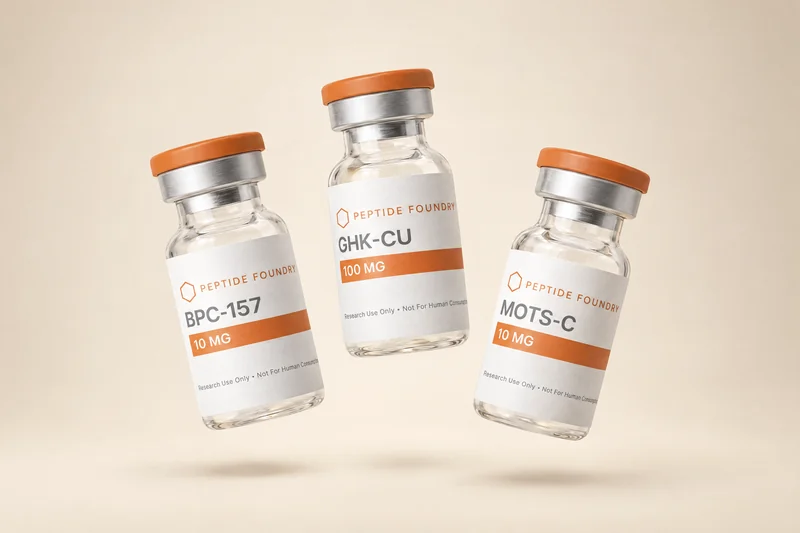
Compare BPC-157 and TB-500 as research peptides: CAS/formula anchors, pathway-class themes in preclinical literature, and when a co-lyophilized blend fits lab workflows. Research use only.
BPC-157 and TB-500 are not the same research peptide. Their registry anchors, elemental formulas, molar masses, and naming problems differ. BPC-157 is commonly described as a synthetic 15-residue peptide. Peptide Foundry’s TB-500 listing is anchored to CAS 77591-33-4, formula C212H350N56O78S, and 4963.44 g/mol, while open-market use of “TB-500” can blur full thymosin beta-4 and fragment descriptions. That makes documentation more important than nickname recognition.
This comparison stays at research-reagent level: chemical identity, sequence literacy, pathway classes reported in preclinical literature, fixed-ratio logistics, and lot-specific certificate verification. It does not turn pathway observations into claims about people. Research use only; not for human or veterinary use.
Key points
- Different substances: BPC-157 is listed at CAS 137525-51-0 and 1419.55 g/mol; Peptide Foundry’s TB-500 listing is CAS 77591-33-4 and 4963.44 g/mol.
- Sequence literacy differs: the public BPC-157 sequence is often written
GEPPPGKPADDAGLV. Verify the lot by COA and mass spectrometry rather than accepting sequence text alone.- TB-500 naming is noisy: match the seller’s CAS, formula, expected mass, identity method, and lot record. Do not assume every TB-500 listing represents the same molecular construct.
- Pathway classes are not product outcomes: BPC literature includes VEGFR2/VEGF-associated, nitric oxide, FAK-paxillin, fibroblast, and cell-migration contexts; thymosin beta-4 literature includes G-actin sequestration, actin dynamics, angiogenesis-related themes, and cell-migration contexts.
- The blend is fixed by mass: BPC-157 10 mg + TB-500 10 mg, or 20 mg labeled total. Equal mass does not mean equal molar quantity.
- Lot transparency matters: BPC lot
FO674and blend lotFO890have distinct ILS records and access codes.
Are BPC-157 and TB-500 the same thing?
No. They are separate catalogue analytes, not alternate names for one molecule. A name comparison can obscure the most decisive fields: CAS number, elemental formula, molar mass, sequence or construct description, and analytical confirmation. BPC-157’s pentadecapeptide description and 1419.55 g/mol mass are materially different from the 4963.44 g/mol record used for Peptide Foundry’s TB-500 listing.
The distinction also applies inside a blend. Co-lyophilization places two research materials in one solid matrix; it does not create a new single peptide or merge their registry identities. A BPC-157 + TB-500 label should therefore preserve two component names, two identity anchors, and an explicit mass allocation.
Chemical identity side by side
| Identity field | BPC-157 | TB-500 (Peptide Foundry listing) |
|---|---|---|
| Material class | Synthetic pentadecapeptide | Peptide research material; verify exact listed construct |
| Sequence length | 15 amino acids | Do not infer from the market name; match documentation |
| CAS | 137525-51-0 | 77591-33-4 |
| Formula | C62H98N16O22 | C212H350N56O78S |
| Molar mass | 1419.55 g/mol | 4963.44 g/mol |
| Public sequence convention | GEPPPGKPADDAGLV is frequently published |
Market descriptions vary; do not copy an unverified competitor sequence |
| Minimum identity check | Lot match + expected mass + analytical identity result | Lot match + CAS/formula/mass alignment + analytical identity result |
A CAS number is an anchor, not a complete assay package. Formula and expected molar mass should agree with the named material, and the certificate should tie an identity method to the physical lot. HPLC can characterize chromatographic purity under a stated method; MS or LC-MS can compare observed ions with expected molecular mass. Neither a storefront name nor a purity percentage alone answers every identity question.
Sequence and naming literacy
BPC-157: a readable sequence still needs analytical support
The public BPC-157 sequence is commonly rendered as GEPPPGKPADDAGLV, a 15-letter one-letter amino-acid string. That is useful for sequence literacy: it can be counted, checked for transcription errors, and compared with an expected mass calculation. It is not proof that the contents of a particular container match the string. A purchaser should still match vial lot to COA, then read the identity method and observed mass data when those data are published.
Sequence display also requires format discipline. Salt form, terminal conventions, counterions, moisture, and analytical reporting can affect how a supplier presents calculated versus measured values. The correct response to a discrepancy is not to force the sequence and headline number to agree; it is to inspect the method notes and ask which material form the laboratory tested.
TB-500: resolve the name before comparing listings
“TB-500” is used inconsistently across the open market. Some pages treat it as equivalent to full thymosin beta-4; others describe an associated fragment or synthetic construct. Those statements cannot all be imported into a different seller’s listing. For Peptide Foundry, start with the published record: CAS 77591-33-4, formula C212H350N56O78S, and molar mass 4963.44 g/mol. Then confirm that the lot certificate’s identity evidence aligns with that record.
| Weak comparison habit | Stronger RUO check |
|---|---|
| Assume every “TB-500” page means the same sequence | Compare CAS, formula, expected mass, and construct description |
| Copy a sequence from a competitor page | Use the sequence or mass assignment tied to the seller’s lot record |
| Treat HPLC purity as sequence confirmation | Separate chromatographic purity from MS-based identity evidence |
| Equate “thymosin beta-4,” “Tβ4,” and “TB-500” without qualification | State which term the source uses and which catalog material is being discussed |
Mechanism families in published preclinical literature
Mechanism language is most useful here as classification. It identifies experimental systems, signaling families, and measured molecular contexts. It does not establish that a catalog product produces a particular result, and it does not make two peptides interchangeable because both appear near a broad theme such as angiogenesis or cell migration.
| Research material or source term | Published pathway class | Typical preclinical context | RUO reading rule |
|---|---|---|---|
| BPC-157 | VEGFR2/VEGF-associated signaling | Endothelial assays, receptor expression/internalization, Akt-eNOS measurements | Record as a receptor-associated class; do not convert it into a catalog-product outcome |
| BPC-157 | Nitric oxide signaling | eNOS, Src-caveolin-1, and NO-related readouts | Distinguish pathway measurements from whole-material claims |
| BPC-157 | FAK-paxillin and focal-adhesion signaling | Fibroblast spreading, phosphorylation, cytoskeletal, and cell-migration assays | Keep the cell type, assay, and source paper attached to the statement |
| Thymosin beta-4 literature | G-actin sequestration and actin dynamics | Monomer binding, G-actin/F-actin balance, profilin exchange, cytoskeletal organization | Do not automatically assign a full-protein observation to every material marketed as TB-500 |
| Thymosin beta-4 literature | Angiogenesis-related themes | Endothelial, progenitor-cell, VEGF-associated, and cell-migration assay classes | Report the source term and model; avoid cross-product extrapolation |
| BPC-157 and thymosin beta-4 literature | Cell migration | Different cell systems and different molecular frameworks | A shared assay label does not imply a shared mechanism or identical analyte |
The naming boundary matters especially in the thymosin literature. A paper about full Tβ4 can inform the pathway taxonomy that surrounds the market term, but it does not by itself identify the sequence in a TB-500 container. Identity remains an analytical question. Pathway classification remains a literature question. Keeping those two questions separate prevents a citation from standing in for a certificate.
Why co-lyophilize BPC-157 + TB-500?
The defensible answer is research-reagent logistics. A fixed blend can reduce container count, preserve a cataloged mass relationship, and provide a single lot for experiments designed around that combination. The tradeoff is reduced compositional flexibility and more demanding mixed-analyte interpretation. It is not a ranking over single materials.
| Format | Inventory characteristic | Composition control | Analytical consideration |
|---|---|---|---|
| BPC-157 single | One analyte, one lot | BPC variable can be evaluated without a second labeled peptide | Simpler identity and chromatogram attribution |
| Fixed BPC-157 + TB-500 blend | One container, one blend lot, 10 mg/10 mg label | Fixed 1:1 mass split | Both components must be accounted for; aggregate net content is not per-component proof |
| Separate singles | Two containers and potentially two lot records | Independent mass selection for assay design | Separate certificates simplify analyte-level traceability but add record handling |
The blend’s 10 mg / 10 mg split is equal by mass, not by amount of substance. Using the published molar masses, 10 mg corresponds to approximately 7.04 µmol of BPC-157 and 2.01 µmol of the listed TB-500 material. The nominal molar relationship is therefore about 3.5:1, not 1:1. That calculation is identity and stoichiometry literacy; actual content remains lot-measured.
“Wolverine stack” is informal market slang sometimes applied to co-listed or co-lyophilized research reagents. It is not a chemical class, registry name, or analytical standard. Translate the phrase back into component CAS numbers, labeled masses, identity methods, and the lot COA, then leave the nickname behind.
Verify the BPC-157 and BPC-157 + TB-500 lot COAs
Peptide Foundry publishes lot-level fields rather than asking readers to rely on a generic badge. The two examples below are different records: a BPC-157 single and a fixed two-component blend. Access codes support portal matching; they do not replace reading the report.
| Listing | Lot | Lab | HPLC purity | Net content | Access code |
|---|---|---|---|---|---|
| BPC-157 | FO674 |
ILS | 99.75% at 214 nm | 10.26 mg | 3DJ5WZ3C |
| BPC-157 + TB-500, labeled 10 mg/10 mg | FO890 |
ILS | 99.60% at 214 nm | 21.39 mg | 2RQHA7YX |
Read each row in layers. First, match the exact lot. Second, identify what the 214 nm HPLC percentage describes under the laboratory method. Third, compare measured net content with the labeled presentation. FO674 reports 10.26 mg against a 10 mg single listing. FO890 reports 21.39 mg aggregate net content against a 20 mg labeled blend total. The aggregate number does not independently demonstrate that each component measured exactly 10 mg.
For FO890, the strongest interpretation separates four questions: are both component names present, is identity evidence supplied for each expected analyte, what does the chromatographic integration cover, and is net content aggregate or component-resolved? For a deeper workflow, use How to read a peptide COA and Multi-peptide blend COA literacy.
Related Peptide Foundry blends: GLOW and KLOW
BPC-157 and TB-500 also appear as shared components in GLOW and KLOW. These are catalog blend names, not single molecular entities. Compare their complete component lists and labeled totals before comparing the names.
| Blend | Peptide Foundry composition | Labeled total | Research pointer |
|---|---|---|---|
| GLOW | GHK-Cu 50 mg + BPC-157 10 mg + TB-500 10 mg | 70 mg | What is GLOW? |
| KLOW | Same GLOW core + KPV 10 mg | 80 mg | What is KLOW? |
KLOW adds one analyte and 10 mg to the Peptide Foundry convention. That means one more identity field and another variable in a mixed-material design; it does not establish a superior format. See GLOW vs KLOW for the direct composition and COA comparison.
Lyophilized-material storage
For sealed lyophilized research material, retain the original lot identifier, protect the container from light and moisture, and store at -20°C. Minimize freeze-thaw events and unnecessary temperature excursions. Keep inventory records tied to the lot and its certificate so an assay record can be traced back to the received material. Follow the product label and laboratory documentation when they state tighter controls.
Frequently asked questions
Is BPC-157 another name for TB-500?
No. Their CAS numbers, formulas, molar masses, and identity records differ. A co-lyophilized blend contains two labeled research materials.
Does equal 10 mg/10 mg content mean equal molecules?
No. Equal mass is not equal molar quantity when molecular masses differ. The published values imply approximately 7.04 µmol versus 2.01 µmol before lot-specific content is considered.
Can the sequence GEPPPGKPADDAGLV identify a BPC-157 lot by itself?
No. The string is a useful public identity convention, but physical-lot confirmation requires matching documentation and an appropriate analytical identity method.
Why not state one definitive TB-500 sequence?
Because market naming varies between full thymosin beta-4 and fragment or construct descriptions. This page does not import a competitor sequence into Peptide Foundry’s listing. It anchors the comparison to CAS 77591-33-4, formula, molar mass, and lot evidence.
Does 99.60% HPLC prove a 10 mg/10 mg split?
No. Chromatographic purity and component mass allocation are different questions. FO890’s 21.39 mg is an aggregate net result unless the report separately resolves component content.
Where can the research materials be reviewed?
See the gated BPC-157 research material and BPC-157 + TB-500 research blend pages for current listing fields and lot panels. These links are research-catalog handoffs, not selection advice.
Selected references and further reading: Hsieh et al., Journal of Molecular Medicine (2017), DOI 10.1007/s00109-016-1488-y, for VEGFR2/Akt/eNOS pathway context; Chang et al., Journal of Applied Physiology 110 (2011), DOI 10.1152/japplphysiol.00945.2010, for fibroblast, FAK-paxillin, and cell-migration assay context; Xue et al., Nature Communications 5 (2014), DOI 10.1038/ncomms6294, for thymosin-β4/profilin exchange and actin dynamics; Qiu et al., Journal of Cardiovascular Pharmacology 53 (2009), for thymosin-β4, PI3K/Akt/eNOS, and cell-migration context. Research guides: GLOW identity, GLOW vs KLOW, KLOW identity, GHK-Cu research identity, COA literacy, blend COA literacy, USA research-peptide vendor criteria, and Lyophilized reconstitution (BAC vs AA).
