
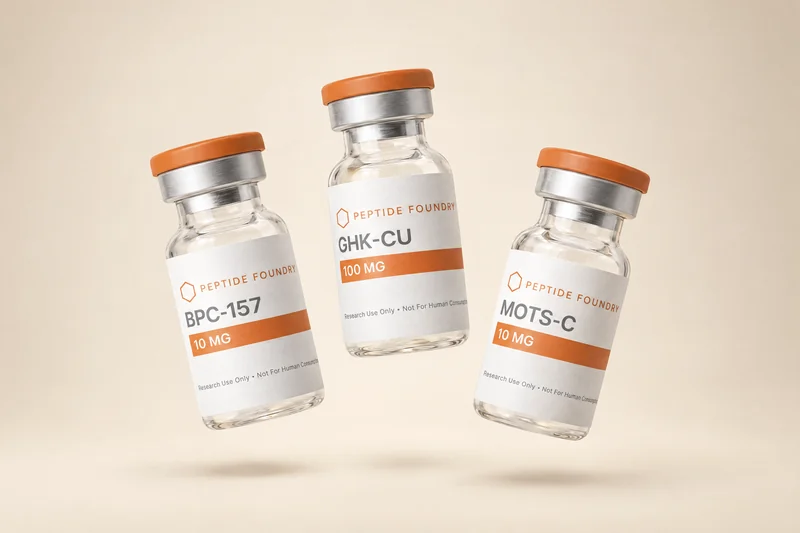
KLOW is a four-peptide research blend (GHK-Cu, BPC-157, TB-500, KPV), not one molecule. See CAS anchors, Peptide Foundry’s 50/10/10/10 mass ratio, and how to match a lot COA. Research use only.
KLOW is a market label for a co-lyophilized four-peptide research material combining GHK-Cu (CAS 49557-75-7), BPC-157 (CAS 137525-51-0), TB-500 (CAS 77591-33-4), and KPV (CAS 67727-97-3). It is not a single CAS-registered molecule.
If you found “klow peptide,” “klow blend,” or “klow 50” in a catalogue, a spreadsheet, or a vendor listing, the useful questions are which four components are present, what mass of each is in the vial, and how the lot is documented. Listing names vary between suppliers. Registry numbers and lot certificates do not.
This page covers what the designation means, Peptide Foundry’s fixed mass ratio, per-component identity anchors (including KPV as Lys-Pro-Val), and how to match a vial lot to a third-party certificate of analysis.
Key points
- KLOW is a blend label, not a single CAS substance.
- Peptide Foundry vial convention: GHK-Cu 50 mg + BPC-157 10 mg + TB-500 10 mg + KPV 10 mg (label
50mg/10mg/10mg/10mg; 80 mg total peptide content).- Each component has its own CAS, formula, and molar mass — see the identity table below.
- KPV is the tripeptide Lys-Pro-Val (α-MSH C-terminal sequence fragment); identity stops at chemistry, not outcome language.
- Lot certificates (for example ILS Laboratories full QC on current lots) can be verified with the issuing laboratory’s access code.
- Research use only — not for human or veterinary use.
What does “KLOW peptide” mean?
It is a catalogue label, not a chemical name. No naming authority — IUPAC, CAS, or WHO — registers “KLOW” as a substance.
That is why the same four-letter word appears inconsistently across sources: klow peptide, klow blend, klow stack, klow 50, KLOW. A label that exists only in catalogues can be spelled several ways, reused, or applied to different mass splits. None of that tells you what is in a particular vial.
Mnemonic literacy helps inventory more than chemistry. In supplier copy, the leading “K” is commonly read as a pointer to KPV. That mnemonic is a search aid, not a registry proof. Never infer the full component list from the acronym alone.
In practice, most market listings that use the KLOW name point at a four-component co-lyophilized preparation built from GHK-Cu, BPC-157, TB-500, and KPV. The components are real, individually registered peptides. The blend name is not. Treat “KLOW” the way you would treat any other vendor shorthand: useful for search and inventory, useless as an identity proof on its own.
How can I confirm what a KLOW listing refers to?
Do not stop at the marketing name. Three checks, in order of usefulness:
- Name the four components and their CAS numbers. GHK-Cu is CAS 49557-75-7; BPC-157 is CAS 137525-51-0; TB-500 (as listed for thymosin β-4 in this catalogue) is CAS 77591-33-4; KPV is CAS 67727-97-3. Each resolves in a public registry independently of any supplier’s copy.
- Read the labeled masses. Peptide Foundry’s KLOW is labeled
50mg/10mg/10mg/10mg— 50 mg GHK-Cu, 10 mg BPC-157, 10 mg TB-500, and 10 mg KPV. Other vendors may use a different split under the same marketing name. Compare certificates and labels, not acronyms. - Read the lot certificate. A COA ties one physical lot to measured purity and identity. A catalogue name cannot do that.
Product names are marketing artefacts. CAS numbers and lot records are not.
What are the four components?
Each component is a separately registered research material. The table below is the identity set Peptide Foundry uses for KLOW; values match the catalog chemistry table and the live product blend panel.
| Component | CAS# | Formula | Molar mass | Mass per vial |
|---|---|---|---|---|
| GHK-Cu | 49557-75-7 | C14H22CuN6O4 | 401.91 g/mol | 50 mg |
| BPC-157 | 137525-51-0 | C62H98N16O22 | 1419.55 g/mol | 10 mg |
| TB-500 | 77591-33-4 | C212H350N56O78S | 4963.44 g/mol | 10 mg |
| KPV | 67727-97-3 | C16H30N4O4 | 342.43 g/mol | 10 mg |
GHK-Cu
GHK-Cu is a copper-complexed tripeptide. The CAS number 49557-75-7, formula C14H22CuN6O4, and molar mass 401.91 g/mol are the anchors. Peptide Foundry’s catalog uses the formula-consistent 401.91 value. Keep the discussion at chemical identity — the copper complex is a structural fact, not a clinical claim. For single-component depth, see GHK-Cu research identity.
BPC-157
BPC-157 is a synthetic pentadecapeptide registered as CAS 137525-51-0, formula C62H98N16O22, molar mass 1419.55 g/mol. It appears both as a single listing and as a component in multi-peptide blends. Match the CAS and mass on the certificate; do not rely on the nickname alone.
TB-500
TB-500 is the market name commonly applied to material listed under CAS 77591-33-4 (thymosin β-4), formula C212H350N56O78S, molar mass 4963.44 g/mol. Market naming is noisy across vendors. Match CAS + molar mass on the COA, not the nickname on the storefront.
KPV
KPV is the tripeptide Lys-Pro-Val (lysyl-prolyl-valine). It is registered as CAS 67727-97-3, formula C16H30N4O4, molar mass 342.43 g/mol. Supplier and literature language often describes it as the C-terminal tripeptide fragment of α-melanocyte-stimulating hormone (α-MSH). That is a sequence-class identification fact — three residues at the C-terminus of a longer peptide hormone class — not a product claim for the blend. This page stops at chemical identity for KPV; it does not translate sequence class into outcome language.
What fixed ratio does Peptide Foundry use?
Peptide Foundry supplies KLOW as a single lyophilized vial with a fixed mass ratio:
| Component | Mass per vial | Share of labeled peptide content |
|---|---|---|
| GHK-Cu | 50 mg | 50 / 80 (62.5%) |
| BPC-157 | 10 mg | 10 / 80 (12.5%) |
| TB-500 | 10 mg | 10 / 80 (12.5%) |
| KPV | 10 mg | 10 / 80 (12.5%) |
| Total | 80 mg | 100% |
The size attribute on the product listing is 50mg/10mg/10mg/10mg. That string is a mass label, not a molar ratio. The four components differ in molar mass by more than an order of magnitude (roughly 342, 402, 1,420, and 4,963 g/mol), so equal milligram amounts are not equal molar amounts. For assay math, convert with the molar masses in the identity table rather than treating the milligram ratio as stoichiometric.
Mass order on a size string does not always match COA header order. Peptide Foundry maps 50 / 10 / 10 / 10 to GHK-Cu / BPC-157 / TB-500 / KPV. Read the masses next to the named components. Other vendors may publish a different split under the same marketing name — compare labeled milligrams and the certificate, not the brand word.
Specifications
| Property | Value |
|---|---|
| Listing name | KLOW |
| Type | Four-peptide co-lyophilized blend (not a single CAS substance) |
| Components | GHK-Cu, BPC-157, TB-500, KPV |
| Labeled mass ratio | 50 mg / 10 mg / 10 mg / 10 mg (80 mg total) |
| Physical form | Lyophilized powder |
| Appearance | White to off-white solid |
| Purity specification | ≥99% by HPLC (lot-specific measured value on COA) |
| Documentation | Lot-specific third-party COA |
How does KLOW relate to GLOW?
Both listings share the GHK-Cu / BPC-157 / TB-500 core at Peptide Foundry’s published masses. KLOW adds KPV, bringing the labeled total from 70 mg to 80 mg. That is component count and mass sum — not a ranking of one blend over the other.
| Listing | Components | PF label | Labeled total |
|---|---|---|---|
| GLOW | GHK-Cu, BPC-157, TB-500 | 50mg/10mg/10mg |
70 mg |
| KLOW | GHK-Cu, BPC-157, TB-500, KPV | 50mg/10mg/10mg/10mg |
80 mg |
The fourth analyte adds another identity field and another peak set to account for in chromatography. That is logistics and design complexity. Neither blend is more advanced; identity and documentation are the point of this page. See What is the GLOW research blend? and GLOW vs KLOW.
How do you verify a KLOW lot COA?
A certificate of analysis is stronger when it is lot-specific, names the laboratory, and can be checked outside the supplier’s own site. For multi-peptide blends, the certificate should make the four-component list and labeled masses unambiguous. Full workflow: How to read a research-peptide COA. Blend-specific checks: How to verify a multi-peptide blend COA.
What a blend COA should show
- A lot number that matches the vial.
- Clear attribution of the four components (or identity data that can be tied to them).
- Purity method and wavelength (for example HPLC @ 214 nm).
- Net peptide content versus the labeled mass.
- Where claimed: heavy metals, sterility, endotoxin, and illicit-substance screens.
A red flag is a single “blend purity %” with no lot number, no laboratory name, no component list, and no way to confirm the document exists outside the seller’s PDF host.
Worked example — lot FO993
As published on the current Peptide Foundry KLOW listing (SKU PF-KLOW) at the time of writing:
| Field | Value |
|---|---|
| Lot | FO993 |
| Size | 50mg/10mg/10mg/10mg |
| Laboratory | ILS Laboratories (ISO/IEC 17025 narrative) |
| Purity | 99.61% (HPLC @ 214 nm) |
| Net peptide content | 82.4 mg |
| Access code | RATK8CGX |
Three steps that travel with any lot, not just this one:
- Match the lot number on the vial to the lot on the certificate.
- Confirm the four components and labeled masses against the certificate and the product label (50 / 10 / 10 / 10 → GHK-Cu / BPC-157 / TB-500 / KPV).
- Verify the access code on the issuing laboratory’s own portal when one is provided — not only by opening a PDF hosted by the supplier. For lot FO993, that code is RATK8CGX.
A PDF on a supplier site is a document the supplier controls; a record from the testing laboratory is not. Prefer the certificate that matches the lot in hand. Net peptide content can differ from the labeled sum — FO993 reports 82.4 mg net against an 80 mg labeled total. That is a measured field, not a contradiction of the size label.
Blend vial versus four separate vials
The four materials are the same research substances whether they arrive in one co-lyophilized vial or four singles. A blend fixes the mass stoichiometry and reduces vial count for workflows that use this ratio. Separate vials fit assays that need independent concentration control of each component. That is logistics, not a protocol — solution preparation belongs to your institution’s SOPs. Neither format changes the research-use-only boundary.
How should it be stored and handled?
Standard laboratory practice for lyophilized synthetic peptides applies to multi-peptide vials as well:
- Storage. Sealed vials at −20°C, protected from light and moisture. Lyophilized material is substantially more stable than solution.
- Temperature excursions. Brief ambient exposure in transit is normal for lyophilized material. Return vials to −20°C on arrival.
- Freeze–thaw. Minimize repeated freeze–thaw. Storage stability and handling frequency are separate facts on a certificate for a reason.
- Traceability. Keep the lot number with the material. Lot number is what ties a vial back to its certificate; material separated from its lot number cannot be traced to any analysis.
Specifics beyond lyophilized storage depend on your assay and your institution’s SOPs.
Common questions
Is KLOW a single peptide?
No. KLOW is a market label for a four-peptide co-lyophilized blend. There is no single CAS registry entry for “KLOW” as a substance. Identity is the four component CAS numbers plus the labeled mass of each.
What does 50mg/10mg/10mg/10mg mean?
It is the mass of each component in one Peptide Foundry vial: 50 mg GHK-Cu, 10 mg BPC-157, 10 mg TB-500, and 10 mg KPV (80 mg total labeled peptide content). It is a mass label, not a molar ratio.
What is KPV chemically?
KPV is Lys-Pro-Val (CAS 67727-97-3), formula C16H30N4O4, molar mass 342.43 g/mol. Literature often identifies it as the α-MSH C-terminal tripeptide fragment. That is sequence identity only.
How do I verify what I received?
Match the lot number on the vial to the COA, confirm the four components and masses, and use the laboratory access code on the issuing lab’s verification portal when one is provided. For current ILS-tested Peptide Foundry lots, that means the ILS access code on the certificate — for lot FO993, RATK8CGX.
How does KLOW differ from GLOW?
In Peptide Foundry’s catalog, KLOW uses the same three masses as GLOW and adds KPV 10 mg. That is a component-count difference, not a quality hierarchy. See GLOW vs KLOW.
Can this be used outside a laboratory?
No. This material is supplied for in-vitro and laboratory research by qualified researchers and for no other purpose. It is not a drug, not a supplement, and not for human or veterinary use.
For the current lot certificate and product specifications, see the gated KLOW research product page. Related library reading: What is the GLOW research blend?, GLOW vs KLOW, BPC-157 vs TB-500, How to read a research-peptide COA, How to verify a multi-peptide blend COA, and GHK-Cu research identity.
Research use only. Nothing on this page describes or implies use in humans or animals.
