
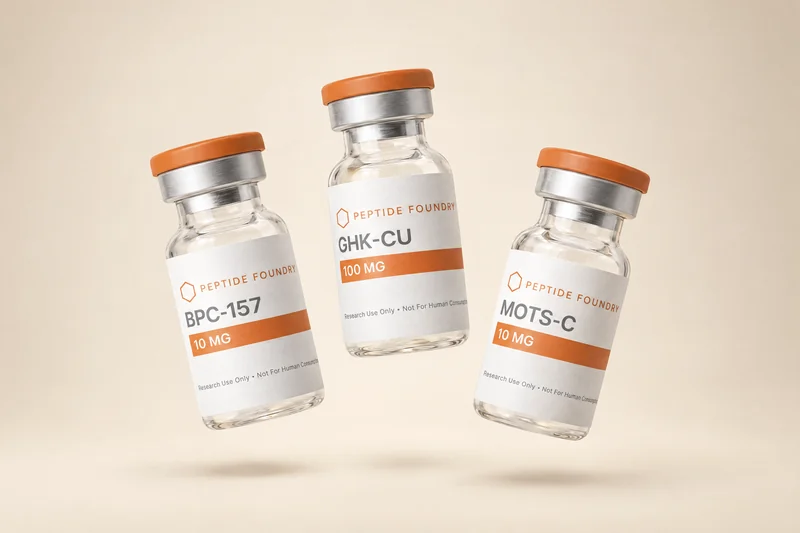
Lab guide to reconstituting lyophilized research peptides — bacteriostatic water vs AA (acetic acid) water, aseptic bench technique, and storage of reconstituted solutions. Research use only.
Lyophilized research peptides arrive as a dried cake. On the bench, reconstitution means dissolving that solid into a documented aqueous diluent so the laboratory can prepare stocks for assays, chromatography, or other controlled methods. Diluent choice is a chemistry and documentation decision — not a personal handling schedule.
This page is Peptide Foundry’s public lab-bench guide to two live diluent SKUs: bacteriostatic water (BAC; sterile water with 0.9% benzyl alcohol) and AA water (0.6% acetic acid in sterile water). It covers reconstitution as research practice, catalog chemistry for each diluent, a worked BAC COA (lot BW2689), preservative versus solvent selection, aseptic transfer at a high level, storage for cake versus diluent versus reconstituted solution, and quality documentation. Volumes and target concentrations belong to institution SOPs and assay targets — this page does not publish them. Research use only.
Key points
- Reconstitution at the research bench is dissolving a lyophilized cake into a characterized diluent under lab SOP — not a personal recipe or compound-specific protocol catalog.
- BAC water (SKU
PF-BACTERIOSTATIC-WATER): sterile water + 0.9% benzyl alcohol; USP; pH 5.0–7.0; 10 ml / 30 ml; preservative supports controlled multi-use after first puncture per label.- AA water (SKU
PF-AA-WATER): 0.6% acetic acid in sterile water; 30 ml; acetic acid is a solvent, not a preservative — aseptic aliquot and discard unused portion.- Claim vs evidence: BAC publishes Freedom Diagnostics lot BW2689. AA has no public Freedom Diagnostics COA panel on the live PDP at write time — request or check lot docs when published.
- Research use only — not for human or veterinary use.
What reconstitution means at the research bench
In laboratory practice, reconstitution is the controlled dissolution of a lyophilized solid into a diluent so that a documented aqueous research stock can be prepared. The cake, the diluent identity, the aseptic transfer method, appearance QC, and lot paperwork form one documentation trail.
This page compares two Peptide Foundry diluent chemistries on claim-versus-evidence terms, separates preservative function (benzyl alcohol in BAC) from solvent / pH function (acetic acid in AA), and points researchers at SOPs for volumes, concentrations, hold times, and assay targets. It does not publish personal volume worksheets, compound-specific human recipes, administration scripts, or day calendars for individual use. Those frames belong outside an RUO lab-bench guide. Target volumes and concentrations are method parameters owned by the institution’s controlled documents and the assay design — record that constraint in the notebook before you open a vial.
Bacteriostatic water (BAC): chemistry and PF catalog
Bacteriostatic water is sterile water containing 0.9% benzyl alcohol as a preservative. That preservative inhibits bacterial growth under labeled multi-use conditions — the usual reason BAC is selected when an SOP allows repeated aseptic withdrawals from the same diluent vial within a stated post-puncture window. The live chemistry table publishes water identity for this SKU (H2O registry line below); do not invent a separate benzyl alcohol CAS on this page.
Catalog chemistry table — BAC
| Field | Peptide Foundry catalog (live /product/bacteriostatic-water/) |
|---|---|
| Name | Bacteriostatic water (BAC) |
| SKU | PF-BACTERIOSTATIC-WATER |
| Composition | Sterile water + 0.9% benzyl alcohol (USP) |
| CAS (published water identity) | 7732-18-5 |
| Formula (published) | H2O |
| Molar mass (published) | 18.015 g/mol |
| pH (label range) | 5.0–7.0 |
| Sizes | 10 ml / 30 ml |
| Role | Preserved aqueous diluent for lyophilized research materials |
About copy on the live PDP: unopened shelf life approximately 2 years from manufacture; store unopened at 15–25 °C, away from sunlight, do not freeze; after first puncture refrigerate 2–8 °C, use within 28 days with sterile technique; discard if cloudy or discolored.
Worked COA example — lot BW2689
As published on the Peptide Foundry bacteriostatic-water documentation panel at the time of writing:
| Field | Value |
|---|---|
| Product | Bacteriostatic Water (BAC) — 10 ml |
| Lot | BW2689 |
| Laboratory | Freedom Diagnostics |
| COA number | 2607301332 |
| Report date | 08/04/2026 |
| Appearance | Clear Liquid |
| pH | 5.6 |
| Test method | LC-MS identity / PCR microbial |
| Microbial analysis (PCR) | No Detectable Microbial DNA |
Read the table as a single-lot transparency example. LC-MS identity and PCR microbial results answer different questions than HPLC purity on a peptide lot — the same rule still applies: match the lot on the vial to the lot on the certificate. Prefer the issuing laboratory’s record when a portal path exists. Lot panels rotate; re-check the live BAC product page and the certificate tied to the vial you hold. Verification literacy: How to read a research-peptide COA.
AA water: chemistry, solvent role, and when labs choose AA vs BAC
AA water is sterile water containing 0.6% acetic acid, producing a mildly acidic diluent. Certain lyophilized research materials show limited solubility near neutral pH and dissolve more readily in a mildly acidic matrix — a solubility reason, not a ranking of diluents by “strength.” On the live AA page, acetic acid is a solvent, not a preservative: unlike benzyl alcohol in BAC, it is not added to support multi-use withdrawals under a preservative window.
Catalog chemistry table — AA
| Field | Peptide Foundry catalog (live /product/aa-water/) |
|---|---|
| Name | AA water |
| SKU | PF-AA-WATER |
| Composition | 0.6% acetic acid in sterile water |
| CAS | 64-19-7 |
| Formula | C2H4O2 |
| Molar mass | 60.05 g/mol |
| Size (live option) | 30 ml |
| Role | Acidic aqueous diluent (solvent function; not a preservative) |
Storage reconciliation (claim vs accordion): About copy is primary — store at 15–25 °C, away from sunlight, do not freeze; because the solution is unpreserved, use aseptic technique when aliquoting and discard unused portion rather than relying on a multi-use preservative window; discard if cloudy or discolored. The Storage accordion on the live PDP also mentions 2–8 °C. When lab practice requires refrigeration of opened diluent, follow the SOP and controlling label; do not invent a third “house” policy beyond quoting About as primary and noting refrigeration when practice requires it.
COA status at write time: There is no public Freedom Diagnostics COA panel on the AA PDP. Do not invent an AA lot certificate. Request or check current lot documentation when published, and apply the same batch-match discipline as for any other RUO reagent.
Preservative vs solvent — decision table
| Decision factor | BAC water | AA water |
|---|---|---|
| Primary chemistry job | Preserved sterile water diluent | Mildly acidic solvent diluent |
| Additive role | 0.9% benzyl alcohol (preservative) | 0.6% acetic acid (solvent / pH) |
| Typical reason to choose | SOP allows multi-use diluent within labeled post-puncture window | Poor solubility in near-neutral aqueous diluent; method calls for acidic first dissolution |
| Multi-use preservative window | After first puncture: 2–8 °C, within 28 days, sterile technique | Unpreserved — aseptic aliquot; discard unused |
| Published lot panel (write time) | Yes — Freedom Diagnostics BW2689 | None on PDP — request/check when published |
Optional high-level two-step literacy
Some laboratory SOPs dissolve a poorly soluble lyophilized cake first in a small volume of acidic diluent, then bring the stock to a method-defined aqueous matrix for the assay. That is category literacy about sequential dissolution chemistry — not a recipe, volume table, or compound-specific protocol. If method validation requires a two-step path, volumes, hold times, and final matrix belong in the institution’s SOP and assay worksheet.
pH-sensitive materials (identity context only)
Metal-coordinated peptides and other pH-sensitive research solids can behave differently as solution pH moves. Read identity anchors and lot chemistry before choosing a diluent class — do not invent Peptide Foundry bans or compound blacklists here. For copper-complex identity context, see GHK-Cu research compound. Match diluent choice to documented solubility behavior and the method’s validated pH window.
Aseptic lab technique (high level)
Aseptic technique here means protecting the lyophilized cake, the diluent, and the reconstituted research stock from avoidable contamination during transfer. Use sterile transfer tools appropriate to biosafety and chemical-handling rules. Wipe vial stoppers with an appropriate disinfectant per SOP before puncture. Add diluent as a gentle stream down the inner wall of the peptide vial rather than blasting the cake surface. Do not shake vigorously; swirl or rock until the cake dissolves. Visually inspect before and after: clear and free of unexpected particulates is baseline QC; cloudiness, discoloration, or foreign matter is a stop-and-document event.
What this section is not
This section is not an administration script, not a personal handling calendar, and not permission to invent volumes. It does not teach personal preparation routines. Aseptic transfer tools are lab equipment for moving sterile liquids between vials under SOP. Target volumes and concentrations remain institution / assay parameters.
Before opening either vial: confirm labels, lot numbers, expiry or manufacture dating as applicable, storage compliance, and clear diluent appearance. Record lot IDs for cake and diluent in the notebook or LIMS entry that owns the experiment.
Storage: lyophilized cake vs diluent vials vs reconstituted solutions
Storage is three different documents — not one universal personal day calendar.
| Material state | Controlling guidance (claim framing) | What this page does not publish |
|---|---|---|
| Lyophilized peptide cake (sealed) | Supplier label + lab SOP (cold, dry, light-protected) | Universal “days after open” consumer chart |
| BAC diluent (unopened) | ~2 years from manufacture; 15–25 °C; away from sunlight; do not freeze | Invented shelf-life math |
| BAC diluent (after first puncture) | 2–8 °C; within 28 days; sterile technique; discard if cloudy/discolored | Extensions beyond label without risk assessment |
| AA diluent | About primary: 15–25 °C; unpreserved → aliquot + discard unused; refrigerate when practice requires | False multi-use preservative window |
| Reconstituted research solution | Method-validated hold in institution SOP; discard per waste rules | Personal day-count calendars |
Treat each state separately. A correctly stored sealed cake does not authorize improvisation on an opened diluent; a BAC preservative window does not transfer to an AA vial. Reconstituted aqueous stocks are method materials: hold under validated conditions and document discard. Parallel framing for cofactor solids: NAD+ research compound — formulation adjectives never replace in-house verification.
Quality checks and documentation
Diluent quality and peptide quality are separate evidence chains that meet in the notebook.
- Batch match — lot on vial equals lot on certificate for every material you open.
- Named laboratory and methods — BAC example BW2689: Freedom Diagnostics; LC-MS identity / PCR microbial; COA 2607301332; report 08/04/2026; pH 5.6; Clear Liquid; No Detectable Microbial DNA.
- Appearance QC — clear diluent; cake and reconstituted stock free of unexpected cloudiness or particulates.
- Portal verify when available — prefer the issuing lab’s record over a supplier-only PDF.
- Vendor criteria — USA-sourced RUO purchasing discipline applies to diluents and peptides alike: USA research peptide vendor criteria.
COA literacy (lot match → named lab → methods → panels → portal): How to read a research-peptide COA. For AA water, absence of a public lot panel on the PDP is a documentation fact — request current lot docs rather than inventing certificates here.
FAQ
What is the difference between BAC water and AA water?
BAC is sterile water with 0.9% benzyl alcohol as a preservative (USP; pH 5.0–7.0). AA is 0.6% acetic acid in sterile water — an acidic solvent diluent, not a preservative system. Choose on solubility, method pH, and whether the SOP requires a preserved multi-use diluent vial.
Why does Peptide Foundry publish water CAS on BAC and acetic acid CAS on AA?
Live chemistry-table anchors: BAC publishes water identity CAS 7732-18-5, H2O, 18.015 g/mol; AA publishes acetic acid CAS 64-19-7, C2H4O2, 60.05 g/mol. Match certificate and label claims to those catalog fields. Do not invent extra CAS lines this page does not publish.
What does lot BW2689 show?
Freedom Diagnostics: Clear Liquid, pH 5.6, LC-MS identity / PCR microbial, No Detectable Microbial DNA, COA 2607301332, report 08/04/2026, BAC 10 ml lot BW2689. Cite as a published example; re-verify against the vial and live product page.
Is there a public AA water COA on the product page?
Not at write time. Do not invent one. Request or check current lot documentation when Peptide Foundry publishes it, then batch-match as usual.
Can this page tell me what volume to add to a peptide vial?
No. Volumes and concentrations belong to institution SOPs and assay targets. Personal volume worksheets and compound-specific “recipes” are outside this article’s processor lock.
Where are the diluent product pages?
Gated storefront: Bacteriostatic water (SKU PF-BACTERIOSTATIC-WATER; 10 ml / 30 ml) and AA water (SKU PF-AA-WATER; 30 ml). This research page stays public; account requirements apply on the product side as configured on site.
Next step
Current diluent specs and lot panels: bacteriostatic water and AA water. Related reading: How to read a research-peptide COA, USA research peptide vendor criteria, NAD+ research compound, and GHK-Cu research compound (identity context).
Research use only. Nothing on this page describes or implies use in humans or animals.
