
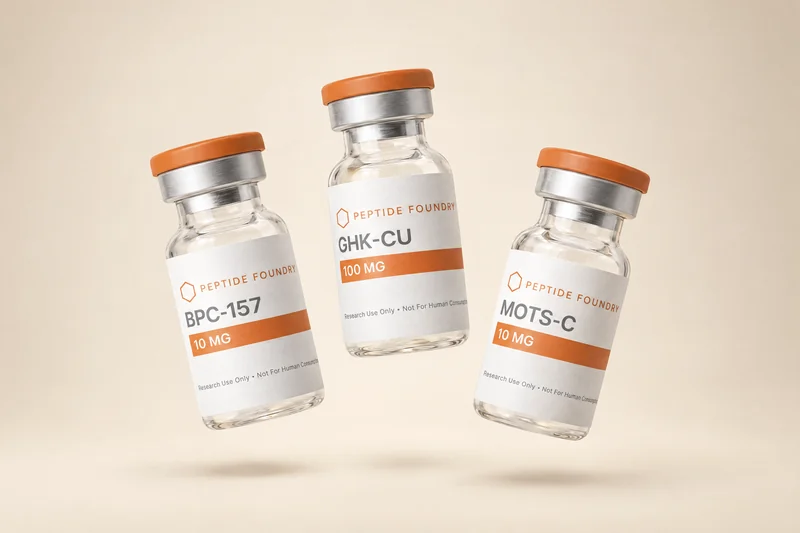
Learn how to read a research-peptide certificate of analysis: match vial lot to COA, weigh named labs, separate HPLC purity from MS identity, and verify access codes on the laboratory’s portal. Research use only.
A research-peptide certificate of analysis is a lot-specific record of identity, purity, and panel results for one physical batch. It is not a marketing badge, and it is not meaningful unless the lot on the vial matches the lot on the certificate.
This page is a verification workflow: batch match → named laboratory → HPLC purity versus mass-spectrometry identity → biosafety and contaminant panels → lab-portal access codes. Examples use lots Peptide Foundry already publishes across ILS Laboratories, Chromate, and Freedom Diagnostics. Research use only.
Key points
- A COA is meaningful only when the lot on the vial matches the lot on the certificate.
- Demand a named laboratory, stated methods (HPLC wavelength / MS), and preferably an independent portal verify path.
- HPLC purity ≠ identity ≠ net peptide content — read all three when present.
- Full QC panels (heavy metals, sterility, endotoxin, illicit screen) are stronger evidence than purity alone.
- Research use only — not for human or veterinary use.
What is a research-peptide COA?
A certificate of analysis for a research peptide is the analytical release record for one batch. At minimum it should name the compound, the lot or batch ID, the test date(s), the laboratory that performed the work, a purity method and result, and an identity method and result.
“Third-party tested” without a named lab and a lot number is an unfinished claim. A pretty PDF that cannot be tied to the vial in your hand is documentation theater.
A usable COA answers four questions in order: which substance, which lot, who measured it, and what methods produced the numbers. If any of those four is missing, stop and ask for the missing piece before you treat the document as evidence.
Step 1: Batch-match the vial to the certificate
Exact lot match
Match the lot number character for character — hyphens, leading zeros, letter prefixes. If the vendor cannot produce the certificate for the lot printed on that vial, that material is undocumented for your purposes.
Generic versus batch-matched documents
A recycled “house” COA reused across lots fails the checklist. The principle is simple: one physical lot, one certificate that names it. Category guides that warn about generic versus batch-matched documents are teaching the same rule; the evidence is the lot string, not the brand of the seller.
Step 2: Named laboratory and accreditation
A named laboratory is stronger evidence than an anonymous “US third-party lab.” Accreditation such as ISO/IEC 17025 is an evidence-weighting signal: it says the laboratory’s quality system has been assessed against a published standard. It does not by itself prove a particular result, and it should not be assumed for every historical lab on every older certificate.
Peptide Foundry’s published research and product pages currently cite work from three laboratories:
| Laboratory | Where it appears on live PF pages | Notes |
|---|---|---|
| ILS Laboratories | Current full-QC lots (for example GLP-3 FO912/FO924, GHK-Cu FO453, GLOW FO996) | Live copy states ISO/IEC 17025; access codes for portal verify |
| Chromate | Older GLP-3 lots (for example 36186, 34208) | RP-HPLC with UV in the published table |
| Freedom Diagnostics | Older GLP-3 lots (for example R10312, R20312) | HPLC-UV / mass spec in the published table |
Do not extend the 17025 claim to Chromate or Freedom unless the certificate or live site copy says so. Weight the evidence you actually have.
Step 3: HPLC purity versus mass-spectrometry identity
What HPLC purity is (and is not)
HPLC purity estimates what fraction of UV-absorbing material in the chromatogram is the main peptide peak under the stated method. Require the method and the wavelength on the certificate (often 214 or 220 nm). A chromatogram is preferred. A purity figure without a wavelength is incomplete.
There is no universal “good enough” purity percentage that replaces reading the lot in front of you. Cite the measured figure on that certificate.
When a chromatogram is attached, look for a dominant main peak and labeled impurity peaks under the stated method. A certificate that quotes purity without showing how the percentage was integrated is harder to defend than one that shows the chromatogram and the wavelength together.
Mass spectrometry (MS) typically accompanies HPLC identity work for research peptides. The observed mass should match the expected molecular weight for the stated sequence within the lab’s stated tolerance. A purity percentage alone does not prove identity; HPLC and MS answer different parts of the same verification story.
What MS / LC-MS confirms
Mass spectrometry checks whether the material’s measured mass matches the expected identity — observed versus theoretical mass. It is orthogonal to HPLC purity. “MS confirmed” without numbers is weak; identity data without a purity method does not describe the impurity load. Credible research COAs report both.
Net peptide content
Label mass and measured peptide content are not the same thing. Water, salts, and counterions can move the net peptide content away from the labeled milligrams. Read the net-content line when it is present; do not treat purity % as a substitute for it.
Worked example from the live GHK-Cu product page at publish time: lot FO453, purity 99.67% by HPLC @ 214 nm, net peptide content 106.71 mg against a 100 mg label, access code EZAZXZ7J (ILS Laboratories). That is why net content belongs on the checklist separately from purity.
Step 4: Endotoxin, sterility, heavy metals, and illicit screens
When a full QC panel is present — the pattern on current ILS-tested Peptide Foundry lots — read these as separate analytical results:
- Heavy metals by ICP-MS against stated limits
- Sterility / no growth
- Endotoxin (for example USP <85>)
- Illicit-substance screen (for example fentanyl — not detected)
These describe composition and contamination panels for research documentation. They are not a safety-for-human-use claim, and they do not replace identity or purity.
Multi-lab purity transparency from the live GLP-3RT research article (confirm lots still cited on that page):
| Lot | Size | Purity | Laboratory | Method | Report date |
|---|---|---|---|---|---|
| FO912 | 12 mg | 99.72% | ILS Laboratories | Full QC panel | 19 Jul 2026 |
| FO924 | 24 mg | 99.62% | ILS Laboratories | Full QC panel | 19 Jul 2026 |
| 36186 | 30 mg | 99.375% | Chromate | RP-HPLC with UV | 17 Jun 2026 |
| 34208 | 10 mg | 99.946% | Chromate | RP-HPLC with UV | 25 Apr 2026 |
| R10312 | 10 mg | 99.904% | Freedom Diagnostics | HPLC-UV / mass spec | 15 Mar 2026 |
| R20312 | 20 mg | 99.894% | Freedom Diagnostics | HPLC-UV / mass spec | 15 Mar 2026 |
Heavy metals for lot FO912 on that same page (illustrative of a full panel, not a universal template):
| Element | Specification | Result |
|---|---|---|
| Arsenic (As) | NMT 1.5 ppm | Not detected |
| Cadmium (Cd) | NMT 0.5 ppm | 0.265 ppm |
| Lead (Pb) | NMT 1.0 ppm | Not detected |
| Mercury (Hg) | NMT 1.5 ppm | Not detected |
| Chromium (Cr) | NMT 10.0 ppm | 0.892 ppm |
Step 5: Lab-portal verification (access codes)
Why a supplier PDF is weaker than a lab record
A PDF hosted by a supplier is a document the supplier controls. A record you can pull from the issuing laboratory’s own verification portal is not. When an access code or report ID is printed on the certificate, use it.
Worked ILS verify walkthrough
- Note the lot and access code on the COA or product COA panel.
- Open the laboratory’s verification portal — type the lab domain yourself; do not blindly trust a vendor QR code that lands on a reseller site.
- Enter the access code.
- Confirm compound, lot, purity figure, and test date match the document you were given.
Examples from live Peptide Foundry pages at publish time:
| Material | Lot | Access code | Where published |
|---|---|---|---|
| GLP-3 (research article) | FO912 | KW9EAGFZ | What is GLP-3RT? (certificate COA-2026-XSTJNR) |
| GHK-Cu | FO453 | EZAZXZ7J | GHK-Cu product COA panel |
| GLOW | FO996 | QY5NMBMV | GLOW product COA panel · identity context: What is the GLOW research blend? |
Other markets use different verify patterns (for example task IDs at community testing labs). Treat those as category literacy. Peptide Foundry’s current full-QC lots use ILS access codes on the live panels above.
If the portal record and the PDF disagree — different purity, different lot, different compound name — trust neither until the laboratory or the vendor resolves the mismatch in writing. Disagreement is itself a red flag.
Red flags checklist
- Unnamed laboratory
- No lot number, or a lot that does not match the vial
- Undated certificate, or dates that precede synthesis / receipt without explanation
- Exactly 100.00% purity with no chromatogram
- Purity without method or wavelength
- Identity asserted without mass-spectrometry (or equivalent) data
- The same PDF reused across multiple lots
- A “verify” link that resolves only on the vendor domain, with no lab-portal path
- A single “blend purity %” with no component list and no lot — especially on multi-peptide vials
Any one of these is enough to pause a purchase decision until the vendor supplies a lot-matched, method-stated certificate from a named laboratory.
Applying this to Peptide Foundry lots
Use the checklist on a live COA panel. Soft examples (account required to browse the storefront; the research library stays open):
- GHK-Cu — FO453 full QC + access code
- GLP-3 — current ILS lots; multi-lab history on the research article
- GLOW — blend lot FO996; see also the GLOW identity page for ratio and per-component CAS
- CJC-1295 + Ipamorelin — practice panel; identity depth: CJC-1295 + Ipamorelin research
- Epithalon — Freedom Diagnostics practice panel; Epithalon COA example
- Semax — ILS practice panel; Semax COA example
Blend-specific pitfalls (a single “blend purity %” with no component attribution) get a dedicated walkthrough on How to verify a multi-peptide blend COA — apply the same lot-match and portal rules and read the component list carefully.
Common questions
Does HPLC purity prove identity?
No. HPLC purity describes the main-peak fraction under a stated UV method. Mass spectrometry (or an equivalent identity method) checks whether that material matches the expected mass. You want both.
Is a supplier PDF enough?
It is weaker than lab-portal verification when an access code exists. Prefer a record you can re-fetch from the issuing laboratory.
What if my vial lot is not on the site?
Ask support for that lot’s certificate. An undocumented lot fails the batch-match step.
Why do older lots show different laboratories?
Vendors change testing partners over time. Peptide Foundry’s published GLP-3 history spans ILS, Chromate, and Freedom Diagnostics. That is useful transparency; it is not a reason to treat every lab as interchangeable. Read the method line and the accreditation claim on the certificate you actually hold.
Does a full QC panel replace identity and purity?
No. Endotoxin, sterility, heavy metals, and illicit screens answer different questions. A clean metals panel with a missing identity method is still an incomplete COA.
Can this material be used outside a laboratory?
No. Research peptides discussed here are supplied for in-vitro and laboratory research by qualified researchers and for no other purpose. They are not drugs, not supplements, and not for human or veterinary use.
Related library reading: USA research-peptide vendor criteria, Peptide Industry Watch, What cGMP compliant means (manufacturing controls vs final test), ISO 5 cleanroom walkthrough (environmental claims vs analytics), How to verify a multi-peptide blend COA, Epithalon COA example (Freedom Diagnostics), Semax COA example (ILS), TH9507 / tesamorelin COA example, CJC-1295 + Ipamorelin, Diluent COA example (BAC lot BW2689), What is GLP-3RT? (multi-lab COA exemplar), What is the GLOW research blend?, and Is glutathione a peptide?.
Research use only. Nothing on this page describes or implies use in humans or animals.
