
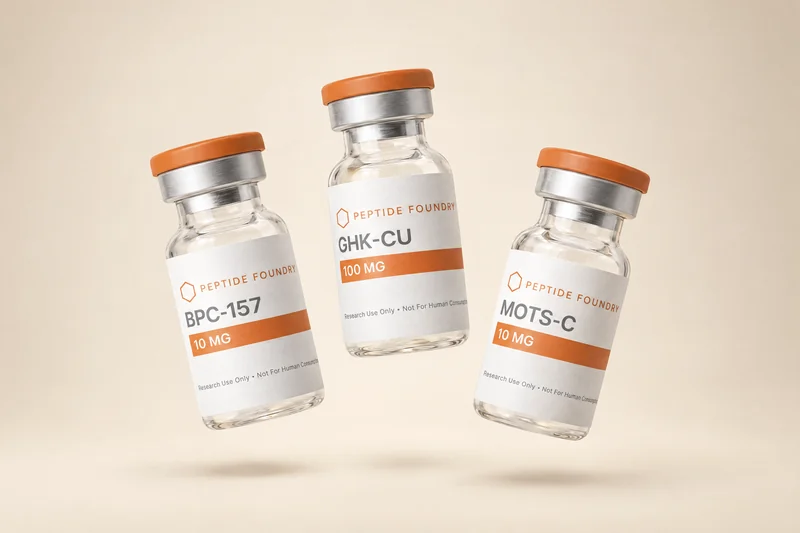
NAD+ is a dinucleotide coenzyme research material — not a peptide. See Peptide Foundry’s CAS/formula anchors, lot COA checks, and buffered vs unbuffered reconstitution chemistry for lab handling. Research use only.
- CAS Number
- 53-84-9
- Molecular Formula
- C21H27N7O14P2 C21H27N7O14P2
- Molar Mass
- 663.4 g/mol
NAD+ (nicotinamide adenine dinucleotide, oxidized form) is a dinucleotide cofactor — not a peptide. Catalogue search terms such as “NAD peptide,” “nad plus peptide,” or “NAD+ research peptide” are common inventory shorthand; they do not change the chemistry class. The useful questions are CAS, molecular formula, molar mass, whether the catalog form is buffered lyophilized solid, and whether the lot certificate matches the vial.
This page is Peptide Foundry’s public identity and buffered-chemistry brief for research buyers. It covers what NAD+ is, why it is not a peptide, the published catalog anchors, buffered versus unbuffered reagent framing for lab pH and stability, a worked COA example from lot FO204, and storage notes for lyophilized material and aqueous research stocks. Soft handoff to the gated product page is at NAD+ research compound. Research use only.
Key points
- NAD+ is not a peptide — it is a dinucleotide cofactor (nicotinamide + adenine nucleotides linked by a pyrophosphate bridge). “NAD peptide” is a search alias, not a structural class.
- Peptide Foundry catalog anchors: CAS 53-84-9, formula C21H27N7O14P2, molar mass 663.4 g/mol; SKU
PF-NAD; buffered lyophilized; size option 1000 mg.- Buffered lyophilized NAD+ is a lab reagent formulation choice (pH control and handling stability in aqueous research stocks) — not a tissue-comfort or wellness claim.
- Demand a lot-matched COA: HPLC purity at a stated wavelength, identity method, net content, and full QC panels when claimed; prefer lab-portal verification.
- Research use only — not for human or veterinary use.
What is NAD+?
NAD+ is the oxidized form of nicotinamide adenine dinucleotide. Structurally it is a dinucleotide: one nucleotide carries a nicotinamide base, the other an adenine base, and the two ribose-5′-phosphate units are joined through a pyrophosphate linkage. That architecture places NAD+ in the cofactor / dinucleotide family used across redox enzymology, not in the amino-acid polymer family that defines peptides and proteins.
In laboratory biochemistry, NAD+ and NADH appear as redox partners in dehydrogenase assays and enzyme kinetics. That cofactor role is a textbook fact — not a reason to rebrand the solid as a “research peptide,” and not a product-use narrative.
A short historical note anchors naming only: Harden and Young’s early twentieth-century work on fermentation cofactors helped establish the coenzyme concept later resolved as NAD+/NADH. That history explains why the molecule appears in enzymology references. It does not authorize clinical, cosmetic, or lifestyle framing on a research catalogue page.
Physical form on research catalogues is typically a lyophilized solid. Peptide Foundry’s published catalog page describes a buffered lyophilized research material under SKU PF-NAD at a 1000 mg size option. Appearance, label mass, and “buffered” wording are formulation and packaging facts. They are not purity proof and they are not a substitute for lot chromatography and identity data.
Market aliases include NAD+, NAD plus, nicotinamide adenine dinucleotide, β-NAD, and — incorrectly as a class label — “NAD peptide.” Aliases help search; registry fields and certificates do identity work.
Is NAD+ a peptide?
No. A peptide is a short chain of amino acids linked by amide (peptide) bonds. NAD+ contains no amino-acid sequence and no peptide backbone. Its formula C21H27N7O14P2 and molar mass near 663.4 g/mol describe a phosphorylated dinucleotide, not a residue string such as Gly-His-Lys or any other oligopeptide.
Why does “NAD peptide” appear in search and seller copy? Research catalogues often group small lyophilized vials under a shared “peptide” storefront taxonomy even when individual SKUs are cofactors, glutathione, or other non-peptide reagents. Category navigation and SEO aliases are not chemical classification. Treating every vial in a peptide storefront as a peptide is a documentation error.
Buyer checklist when a catalog page says “NAD peptide”:
- Does the page publish CAS 53-84-9 (or an explicitly justified alternate registry line) with matching formula and mass?
- Does the COA identity language describe nicotinamide adenine dinucleotide (or an equivalent dinucleotide identity method), not a peptide sequence?
- Is “peptide” appearing only in template headers (for example an HPLC line labeled “peptide purity”) while the substance is clearly a cofactor?
HPLC area-% on a peptide-oriented COA template can still be a valid chromatographic purity estimate for a non-peptide analyte. The word “peptide” on a template field is not class proof. For the general verification workflow, see How to read a research-peptide COA. Related class-clarity reading: Is glutathione a peptide?.
Chemical identity anchors
Peptide Foundry publishes a fixed identity set for NAD+ on the live product chemistry table. Confirm against the current product page if a lot rotates after publish. Product meta for this SKU is keyed as nad; the storefront card auto-renders from that meta.
Catalog chemistry table
| Field | Peptide Foundry catalog (live /product/nad/) |
|---|---|
| Name | NAD+ (nicotinamide adenine dinucleotide, oxidized) |
| CAS | 53-84-9 |
| Formula | C21H27N7O14P2 |
| Molar mass | 663.4 g/mol |
| Class | Dinucleotide cofactor (not a peptide) |
| SKU | PF-NAD |
| Form | Buffered lyophilized |
| Size (live option) | 1000 mg |
Match certificate fields to these claims before you treat a vial as the catalog substance. Nickname-only catalog pages without CAS + formula + mass are unfinished identity claims.
What “buffered lyophilized” means on the PF catalog page
Peptide Foundry’s published form line is buffered lyophilized. In reagent terms, that means the dried cake includes a buffering system chosen so that, when the solid is dissolved into aqueous research stocks, the resulting solution’s pH is constrained toward a target range suitable for lab handling and chromatographic or enzymatic work. The catalog claim is formulation category and handling design — not a disclosed proprietary salt recipe on this research page.
Category literacy across the wider NAD+ reagent market: many research suppliers describe Tris-based or similar buffer systems in secondary literature and competitor datasheets. That is market context only. This page does not attribute a specific buffer salt (Tris or otherwise) to Peptide Foundry. If a lot COA or product insert names a buffer component, use that document; do not invent one from category habit.
What PF claims here, in plain language:
- The material is supplied as a lyophilized solid under SKU
PF-NAD. - The formulation is described as buffered for research stock preparation and lab pH control.
- Identity anchors are CAS 53-84-9, formula C21H27N7O14P2, molar mass 663.4 g/mol.
- Size option published at write time: 1000 mg.
Buffered vs unbuffered NAD+ (lab chemistry)
This section is lab pH and stability literacy for reagent selection. It is not a tissue, comfort, or in-vivo framing section.
What “buffered” means for a lyophilized cofactor
An unbuffered lyophilized NAD+ solid, once dissolved in water or a simple aqueous solvent, yields a solution whose pH is set largely by the compound’s own acid–base behavior, residual counterions, and whatever the solvent contributes. A buffered lyophilized solid carries additional conjugate acid/base capacity so that dissolution tends toward a designed pH band with less drift from small variations in solvent quality or dissolved CO2.
For assay work, enzyme incubations, and HPLC sample prep, that distinction matters because many dehydrogenase and chromatographic methods are pH-sensitive. Holding research stocks inside a stated buffer window reduces one source of run-to-run variability. That is a laboratory control argument, not a physiological claim.
Why pH matters in the lab (not in tissue narratives)
NAD+ participates in hydride-transfer chemistry. Assay rates, enzyme stability, and the integrity of the cofactor itself can shift with pH. Alkaline or poorly controlled aqueous stocks may show faster degradation or assay noise depending on matrix, temperature, and time in solution. Acidic drift can likewise move chromatographic retention or enzyme activity away from a method’s validated window.
Buffered formulation is one way suppliers try to make first-dissolution pH more predictable. Unbuffered material remains usable when the laboratory adds its own characterized buffer at stock preparation — a normal reagent practice. Neither option is “more bioactive” in a catalogue sense; they are different starting points for controlling solution chemistry on the bench.
Choosing buffered vs unbuffered as a research reagent
Choose on documentation and method fit:
- Buffered lyophilized — prefer when you want the supplier’s formulation to constrain initial aqueous pH, when your SOP assumes a buffered cofactor stock, or when you are comparing lots that already publish buffered form language.
- Unbuffered (or free-acid / simple salt) catalog pages — prefer when your method requires you to set buffer composition yourself, or when you need to avoid an unnamed buffer component in a sensitive matrix. Confirm what the seller actually shipped.
- Either way — demand CAS, formula, mass, lot-matched HPLC and identity, and clear form language on the COA or insert. “Buffered” without identity anchors is still an incomplete catalog page.
Peptide Foundry’s live NAD+ SKU is the buffered lyophilized path. Compare competitor form lines the same way you compare CAS lines: read the words, then verify the lot.
Purity panels and worked example (lot FO204)
Most suppliers publish a purity specification. A certificate of analysis is stronger when it is lot-specific, names the laboratory, states methods, and can be checked outside the supplier’s own site. Full checklist: How to read a research-peptide COA.
Minimum fields for a cofactor research COA
- A lot / batch ID that matches the vial character for character
- Test date(s) and a named laboratory
- HPLC purity with method and wavelength (for example 214 nm)
- An identity method (MS and/or HPLC-RTM)
- Net content versus labeled mass when reported
“Third-party tested” or “high purity” without a named lab and a lot number is an unfinished claim. A PDF that cannot be tied to the vial in hand is documentation theater.
Template language note: “peptide purity” on HPLC lines
Some COA templates reuse a “peptide purity” field label even when the analyte is a dinucleotide or another non-peptide. Read that line as chromatographic area-% under the stated method, not as proof that the substance is a peptide. Identity still comes from CAS/formula alignment plus MS or HPLC-RTM (or equivalent). Class errors happen when buyers treat template vocabulary as structure.
Full QC panels (when claimed)
When a full QC panel is present, read each result as a separate analytical claim:
- Heavy metals against stated limits
- Sterility / microbial nucleic-acid or growth result as reported
- Endotoxin (for example a stated EU/mL limit)
These describe composition and contamination panels for research documentation. They are not a safety-for-human-use claim, and they do not replace identity or purity.
Worked example — lot FO204
As published on the Peptide Foundry NAD+ documentation set at the time of writing:
| Field | Value |
|---|---|
| Lot | FO204 |
| Size | 1000 mg |
| Laboratory | Freedom Diagnostics |
| Purity | 99.94% (HPLC @ 214 nm) |
| Net content | 1046.07 mg |
| Identity | HPLC-RTM — Pass |
| Heavy metals | All Pass |
| Sterility | No Microbial DNA (PCR) |
| Endotoxin | ≤0.05 EU/mL |
| Access code | Pept2607210034 |
Read the table as a single-lot transparency example. Net content 1046.07 mg against a 1000 mg label is why net content belongs on the checklist separately from purity %. Prefer verifying the access code on the issuing laboratory’s portal when that path is available — not only a supplier-hosted PDF. Lot panels can rotate; always re-check the live product page and the certificate tied to the vial you hold.
Storage and lab handling
Lyophilized research solids are generally stored cold, dry, and protected from light per the supplier’s label and the laboratory’s SOP. Keep vials closed when not sampling. Treat the label storage statement as the controlling document for the sealed solid.
When preparing aqueous research stocks from lyophilized NAD+, use clean labware, documented solvent or buffer, and standard analytical technique. Prepare only what the experimental plan requires. Hold working solutions under method-validated conditions and discard per lab chemical-waste rules. Avoid open-bench humidity exposure of the bulk solid for longer than needed to weigh or aliquot.
Buffered lyophilized material does not remove method-appropriate handling after dissolution: check research-stock pH when your SOP requires it, and do not treat formulation adjectives as in-house verification. This page does not publish day-count personal handling charts, volume recipes, or use schedules — those belong in laboratory controlled documents, not on a public RUO identity brief.
FAQ
Is NAD+ a peptide?
No. NAD+ is a dinucleotide cofactor. Peptides are amino-acid amide polymers. Catalogue phrases like “NAD peptide” are search and taxonomy aliases, not structural classification. See the dedicated section above and Is glutathione a peptide? for parallel class-clarity reading.
What CAS and formula should match the COA?
Peptide Foundry’s published anchors are CAS 53-84-9, formula C21H27N7O14P2, and molar mass 663.4 g/mol. Match those fields (or any explicitly updated live-catalog set) to the lot certificate before you accept the vial as documented.
What does buffered lyophilized NAD+ mean?
It means the dried research solid includes a buffering system intended to constrain pH when the material is dissolved into aqueous research stocks. That is lab chemistry and handling design. This page does not name a Peptide Foundry buffer salt; market literature often discusses Tris-type systems as category context only.
How do I read an HPLC line that says “peptide purity” on an NAD+ COA?
Treat it as area-% chromatographic purity under the stated method and wavelength — not as evidence that NAD+ is a peptide. Confirm identity separately (HPLC-RTM, MS, or equivalent) and align CAS/formula. Workflow detail: How to read a research-peptide COA.
What does lot FO204 show?
Freedom Diagnostics reported 99.94% HPLC purity at 214 nm, net content 1046.07 mg, HPLC-RTM identity Pass, heavy metals All Pass, sterility No Microbial DNA (PCR), endotoxin ≤0.05 EU/mL, access code Pept2607210034. Cite it as a published lot example; re-verify against the vial and live product page when you purchase.
Where is the product page?
Gated storefront: NAD+ research compound (SKU PF-NAD). This research library page stays public; account requirements apply on the product side as configured on site.
Next step
For the current lot certificate and product specifications, see the NAD+ research product page. Related library reading: Lyophilized peptide reconstitution, How to read a research-peptide COA, GHK-Cu research compound, What is the GLOW research blend?, Is glutathione a peptide?, and What is GLP-3RT?.
Research use only. Nothing on this page describes or implies use in humans or animals.
