
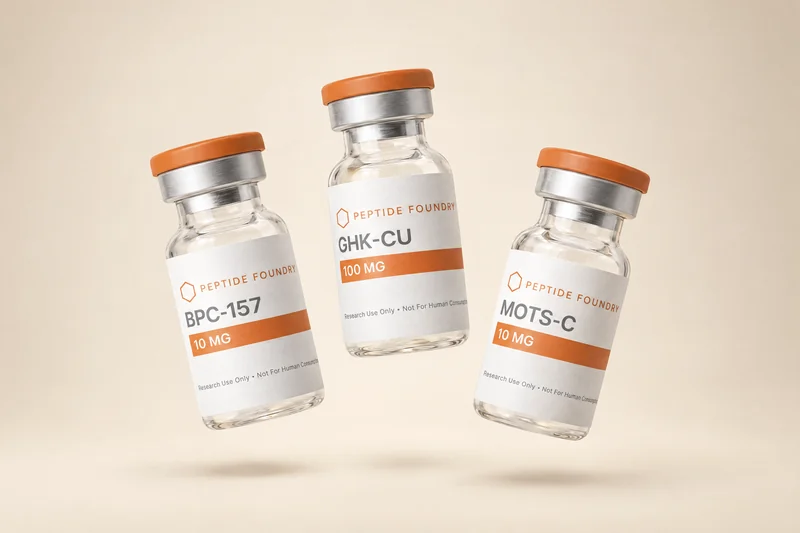
GHK-Cu is a copper(II) complex of Gly-His-Lys. See Peptide Foundry’s CAS/formula anchors, the purity panels to demand on a lot COA, and USA RUO vendor criteria. Research use only.
- CAS Number
- 49557-75-7
- Molecular Formula
- C14H22CuN6O4 C14H22CuN6O4
- Molar Mass
- 401.91 g/mol
GHK-Cu is a copper(II) coordination complex of the tripeptide glycyl-L-histidyl-L-lysine (Gly-His-Lys). It is a discrete research material with its own sequence, formula, and lot documentation — not a brand stack and not a synonym for every listing that says “copper peptide.”
If you found “ghk-cu,” “ghkcu peptide,” “ghk cu,” or “ghk-cu research peptide” in a catalogue, a spreadsheet, or a vendor listing, the useful questions are which CAS and formula the seller claims, whether the certificate describes the copper complex or free GHK, and how the lot is documented. Listing aliases vary. Registry fields and lot certificates do not.
This page covers Peptide Foundry’s published identity anchors, free-GHK versus GHK-Cu as a sourcing check, the purity panels a research buyer should demand, and USA-sourced RUO vendor criteria — then soft-handoffs to the gated GHK-Cu research product page.
Key points
- GHK-Cu = Gly-His-Lys coordinated to copper(II); supplied as lyophilized research material (often described as blue-tinted powder in supplier literature).
- Peptide Foundry catalog anchors (live PDP): CAS 49557-75-7, formula C14H22CuN6O4, molar mass 401.91 g/mol — match certificate fields to these claims; market CAS labeling for free GHK versus the copper complex can differ.
- Demand a lot-matched COA: HPLC purity at a stated wavelength, identity method, net peptide content, and full QC panels when claimed.
- Prefer certificates verifiable on the issuing laboratory’s portal (access code), not only a supplier-hosted PDF.
- Research use only — not for human or veterinary use.
What is GHK-Cu?
GHK-Cu is a copper-binding tripeptide: the ligand is glycine–histidine–lysine, and the metal is copper(II). The coordination complex is the research material discussed on this page. The free tripeptide without coordinated copper is a different substance for sourcing purposes — same three residues, different formula and mass.
The ligand was first characterized in human plasma research in the 1970s (Pickart). That is a historical identification fact. It is not a product claim, not a mechanism story, and not a reason to treat market nicknames as registry proof.
Physical form on research listings is lyophilized solid. Supplier literature often describes the copper complex as blue or blue-green powder. Appearance is a handling observation, not a purity proof and not a substitute for HPLC or identity data on a certificate.
Market aliases include GHK-Cu, GHK Cu, GHKCu, copper peptide GHK-Cu, and copper tripeptide-1 (INCI-adjacent catalogue language). Aliases are useful for search and inventory. They are not identity proof. Treat every alias the way you would treat any other vendor shorthand: useful until you have CAS, formula, molar mass, and a lot-matched certificate.
Chemical identity anchors
Peptide Foundry publishes a fixed identity set for single-vial GHK-Cu. The values below match the live catalog chemistry table and the GLOW research page’s GHK-Cu row. Confirm against the current product page if a lot rotates after publish.
Sequence and composition
Sequence: Gly-His-Lys (glycyl-L-histidyl-L-lysine), copper(II) complex. Residue count: 3 (tripeptide) plus coordinated copper. SKU PF-GHK-CU; size option on the live listing at publish time: 100 mg lyophilized.
CAS, formula, and molar mass
| Field | Peptide Foundry catalog (live /product/ghk-cu/) |
|---|---|
| CAS | 49557-75-7 |
| Formula | C14H22CuN6O4 |
| Molar mass | 401.91 g/mol |
| Sequence | Gly-His-Lys · copper(II) complex |
| Residues | 3 |
| SKU | PF-GHK-CU |
| Form | Lyophilized |
| Size (live option) | 100 mg |
Registry practice across the wider market is inconsistent. Some vendors list the copper complex under CAS 89030-95-5 and reserve 49557-75-7 for copper-free GHK. Others — including Peptide Foundry’s live catalog — publish 49557-75-7 with formula C14H22CuN6O4 and molar mass 401.91 g/mol for the complex. This page does not invent a universal CAS “winner.” The practical rule is: match the vendor’s stated CAS + formula + molar mass to the lot COA, then prefer orthogonal identity (MS / HPLC-RTM) over the nickname alone.
Free GHK versus GHK-Cu (sourcing check)
Free GHK is the tripeptide without coordinated copper (often cited near ~340 g/mol in secondary literature). GHK-Cu is the same ligand with Cu(II); the formula includes copper; catalog masses cluster near ≈401–404 g/mol depending on how formula and hydration are stated. Peptide Foundry’s published mass for the complex is 401.91 g/mol.
Buyer checklist when comparing listings:
- Does the COA formula include Cu?
- Does MS or HPLC-RTM identity language confirm the copper complex, not only the free peptide?
- Do appearance notes or docs claim a copper complex while the CAS line points only at free GHK — or the reverse?
That is a chemical-identity check for purchasing and documentation. Keep it there. Do not treat the free-versus-complex distinction as a clinical or cosmetic comparison.
What purity panels should you demand?
Most suppliers publish a purity specification. A certificate of analysis is stronger when it is lot-specific, names the laboratory, states methods, and can be checked outside the supplier’s own site. For the full verification workflow — batch match, named lab, HPLC versus identity, biosafety panels, portal codes — see How to read a research-peptide COA.
Minimum research COA fields
- A lot / batch ID that matches the vial character for character
- Test date(s) and a named laboratory
- HPLC purity with method and wavelength (for example 214 nm)
- An identity method (MS and/or HPLC-RTM)
- Net peptide content versus labeled mass when reported
“Third-party tested” or “high purity” without a named lab and a lot number is an unfinished claim. A pretty PDF that cannot be tied to the vial in hand is documentation theater.
Full QC panels (when claimed)
When a full QC panel is present — the pattern on current ILS-tested Peptide Foundry lots — read these as separate analytical results:
- Heavy metals by ICP-MS against stated limits
- Sterility / no growth
- Endotoxin (for example USP <85>)
- Illicit-substance screen (for example fentanyl — not detected)
These describe composition and contamination panels for research documentation. They are not a safety-for-human-use claim, and they do not replace identity or purity.
Worked example — lot FO453
As published on the current Peptide Foundry GHK-Cu listing at the time of writing:
| Field | Value |
|---|---|
| Lot | FO453 |
| Size | 100 mg |
| Laboratory | ILS Laboratories (ISO/IEC 17025 narrative on live copy) |
| Tested | 18 Jul 2026 |
| Purity | 99.67% (HPLC @ 214 nm) |
| Net peptide content | 106.71 mg |
| Identity | HPLC-RTM — Pass |
| Fentanyl screen | Not Detected |
| Heavy metals | All Pass |
| Sterility | No Growth |
| Endotoxin | NMT 0.05 EU/mL |
| Access code | EZAZXZ7J |
Multi-lab measured purity published on the same product page spans 99.67% to 99.913% across ILS Laboratories, Chromate, and Freedom Diagnostics (three lots). Older published lots in that range include Chromate 34210 at 99.741% and Freedom Diagnostics GH10312 at 99.913%. Cite those figures as Peptide Foundry–published transparency, not as a universal industry floor.
Three steps that travel with any lot, not just FO453:
- Match the lot number on the vial to the lot on the certificate.
- Confirm CAS, formula, sequence, and labeled mass against the certificate and the product label.
- Verify the access code on the issuing laboratory’s own portal when one is provided — not only by opening a PDF hosted by the supplier.
That last distinction matters. A PDF on a supplier site is a document the supplier controls. A record you can pull from the testing laboratory is not. When evaluating any supplier in this category, independent verification is the question worth asking.
USA-sourced RUO vendor criteria
The SERP for GHK-Cu is crowded with thin buy PDPs, EU/UK pages with cosmetic framing drift, and USA vendors that differ widely in how much identity and lot data they publish before purchase. Category names you will see include American Peptides, Oath, Certified Peptides, Simple, Orbitrex, and Core — among others. Treat them as a category map, not a ranking. Apply one checklist to every supplier, including Peptide Foundry.
| Criterion | What “good” looks like |
|---|---|
| Identity disclosure | Sequence + CAS + formula + molar mass published before purchase; free GHK versus copper complex stated clearly |
| Lot COA | Batch-matched certificate; named laboratory; HPLC wavelength and identity method stated; net content when available |
| Independent verify | Lab-portal access code or accession that resolves on the laboratory’s domain, not only a reseller PDF host |
| Manufacturing claims | cGMP / USA process claims only as the vendor actually states them — ask what the claim covers and what evidence is published |
| Shipping | Thermal / cold-pack policy disclosed. Peptide Foundry site copy: Free 2-day shipping; thermal unmarked shipping is brand practice on live fulfillment copy |
| RUO policy | Explicit research-use-only language; no human-use or cosmetic finished-good framing on the research SKU |
| Traceability | Lot on vial ↔ COA ↔ support can produce the matching certificate for the lot in hand |
Peptide Foundry’s current GHK-Cu lots publish ILS Laboratories full QC with ISO/IEC 17025 narrative and portal access codes on the live product panel. Research-grade framing and USA process language appear as already used on site copy — do not invent certifications beyond what the live pages state. Soft handoff for lot panels and ordering: GHK-Cu research listing (account required for the storefront; this research library stays public).
GHK-Cu single vial versus GLOW
The same GHK-Cu research material appears as a single lyophilized vial and as one component of the GLOW co-lyophilized blend. Peptide Foundry’s GLOW convention is GHK-Cu 50 mg + BPC-157 10 mg + TB-500 10 mg (label 50mg/10mg/10mg). Full blend identity, per-component CAS table, and blend COA matching live at What is the GLOW research blend?; product panel at GLOW.
Separate vials are the better fit when an assay needs independent concentration control of GHK-Cu. A blend fixes mass stoichiometry and reduces vial count for multi-analyte workflows that use that ratio. That is a logistics distinction, not a protocol. How you prepare solutions for a specific assay belongs to your institution’s SOPs, not to a supplier article.
Storage and lab handling
Standard laboratory practice for lyophilized synthetic peptides applies:
- Storage. Sealed vials at −20°C, protected from light and moisture. Lyophilized material is substantially more stable than solution.
- Temperature excursions. Brief ambient exposure in transit is normal for lyophilized material. Return vials to −20°C on arrival.
- Freeze–thaw. Minimize repeated freeze–thaw. Storage stability and handling frequency are separate facts on a certificate for a reason.
- Traceability. Keep the lot number with the material. Lot number is what ties a vial back to its certificate; material separated from its lot number cannot be traced to any analysis.
Specifics beyond lyophilized storage depend on your assay and your institution’s standard operating procedures, which take precedence over any supplier guidance.
Common questions
Is GHK-Cu the same as free GHK?
No. Free GHK is the tripeptide without coordinated copper. GHK-Cu is the copper(II) complex of Gly-His-Lys. Match formula (Cu present or not), molar mass, and lot certificate language — not the shared “GHK” nickname alone.
What CAS should I trust?
Match the vendor’s published anchors to the lot certificate. Peptide Foundry publishes CAS 49557-75-7 with formula C14H22CuN6O4 and molar mass 401.91 g/mol on the live catalog. Other vendors may use 89030-95-5 for the copper complex and reserve 49557-75-7 for free GHK. Registry noise is real; inventing a single “correct” CAS across all catalogs is not useful. Prefer formula + mass + orthogonal identity on the COA.
What makes a GHK-Cu COA usable?
Lot match to the vial, a named laboratory, HPLC purity at a stated wavelength, an identity method, and preferably net peptide content. Stronger documentation adds full QC panels and an access code you can re-check on the issuing laboratory’s portal. Worked FO453 figures and the multi-lab range above are examples of that pattern on Peptide Foundry’s live listing.
How does single-vial GHK-Cu relate to GLOW?
Same GHK-Cu chemistry; GLOW co-lyophilizes it with BPC-157 and TB-500 at a fixed mass ratio. See the GLOW research page for blend identity and COA matching.
Is this for human or cosmetic use?
No. Peptide Foundry supplies GHK-Cu strictly for laboratory and research use by qualified researchers. It is not a drug, not a supplement, not a cosmetic finished good, and not a veterinary product. It is not for use in people or animals.
For the current lot certificate and product specifications, see the GHK-Cu research product page. Related library reading: How to read a research-peptide COA, Full USA RUO vendor checklist, What is the GLOW research blend?, GLOW vs KLOW, Multi-peptide blend COA literacy, BAC vs AA reconstitution (pH-sensitive materials), What is GLP-3RT?, and Is glutathione a peptide?.
Research use only. Nothing on this page describes or implies use in humans or animals.
